
A vehicle can look right on paper and still fall short of the operational brief. Choosing a global vehicle supplier means aligning the vehicle category, any conversion requirements, and the delivery destination. Treating these as separate decisions can make cross-border procurement harder to coordinate and leave important requirements disconnected.
Nafaa Cars brings worldwide vehicle trading and shipping together with premium, commercial, fleet, pickup, and special-purpose vehicles. Its conversion applications include ambulance, mobile clinic, police, military, safari, and VIP use. The process runs from enquiry to delivery. The key question is how well these offerings fit your organisation’s requirement.
This guide explains how to assess vehicle fit, define conversion needs, and include delivery in a procurement brief. It also shows what to include in an enquiry, from vehicle category and intended application to quantity and destination, so the discussion can move towards a personalised quotation.
Key Takeaways
- Assess a global vehicle supplier by how well its vehicle categories and project scope align with your operational brief.
- Identify the relevant category, such as premium, commercial, fleet, pickup, or special-purpose vehicles, before comparing options.
- Decide whether your procurement brief covers vehicle supply alone or includes a specialist conversion for the intended application.
- Bring vehicle category, quantity, application, conversion scope, and destination together in one enquiry for a focused commercial discussion.
- Nafaa Cars provides worldwide vehicle trading and shipping through a stated enquiry-to-delivery process, with personalised quotations for project requirements.
What a global vehicle supplier must deliver for your operation
Cross-border vehicle procurement involves more than identifying a model. The supplier needs to understand the vehicle requirement, its intended use, and the destination. A global vehicle supplier supports buyers sourcing vehicles across national borders and brings these factors into the procurement discussion. The practical test is whether the vehicle category, application, any required conversion, and delivery destination fit the organisation’s brief.
This buyer-focused view differs from browsing a manufacturer’s catalogue or relying on a supplier ranking. The automotive industry includes manufacturing, design, development, and sales. For a buyer, the immediate task is narrower: identify a suitable vehicle and arrange supply for a defined operation. Nafaa Cars provides worldwide vehicle trading and shipping across premium, commercial, fleet, pickup, and special-purpose categories, alongside specialist conversion applications.
What does a global vehicle supplier do?
A vehicle supplier supports the commercial process of sourcing and supplying vehicles. The scope varies: one supplier may focus on a particular category, while another may work across vehicle types or offer specialist conversion. Manufacturers build vehicles, brokers typically facilitate transactions, public marketplaces display listings, and logistics providers focus on moving goods. These roles can overlap, but they are not interchangeable. Buyers should identify which parts of their procurement brief the supplier addresses.
Keep the vehicle transaction distinct from other commercial and operating needs. Financing, rental, and after-sales repair are separate activities, not automatic parts of vehicle supply. Defining the requirement this way helps procurement teams compare equivalent offers and avoid assuming that a vehicle supplier covers every service connected to ownership or operation.
Why operational fit should lead the decision
A vehicle must suit the conditions in which it will work. A fleet requirement differs from a pickup requirement, and a specialist application may call for a conversion brief as well as a base vehicle. Nafaa Cars’ conversion applications include ambulance, mobile clinic, police, military, safari, and VIP use. State the operational purpose early to connect the vehicle category with the intended configuration and destination.
Supplier fit means aligning the vehicle category, intended use, conversion scope, and delivery destination in one procurement brief. This is a more useful decision standard than catalogue size or a general supplier ranking. For example, an organisation planning mobile clinic operations should describe the application and conversion need alongside its vehicle requirement, rather than leaving conversion as a separate, later decision.
Before making an enquiry, write down the core elements of the brief:
- Vehicle category: Premium, commercial, fleet, pickup, or special-purpose.
- Application: The operational role the vehicle is expected to support.
- Conversion scope: The specialist use the vehicle must be prepared for, if applicable.
- Destination: Where the vehicle needs to be delivered.
With these points defined, you can assess whether a supplier’s scope matches the work to be done, rather than judging by the apparent breadth of its catalogue.
Match a global vehicle supplier to your vehicle and conversion needs
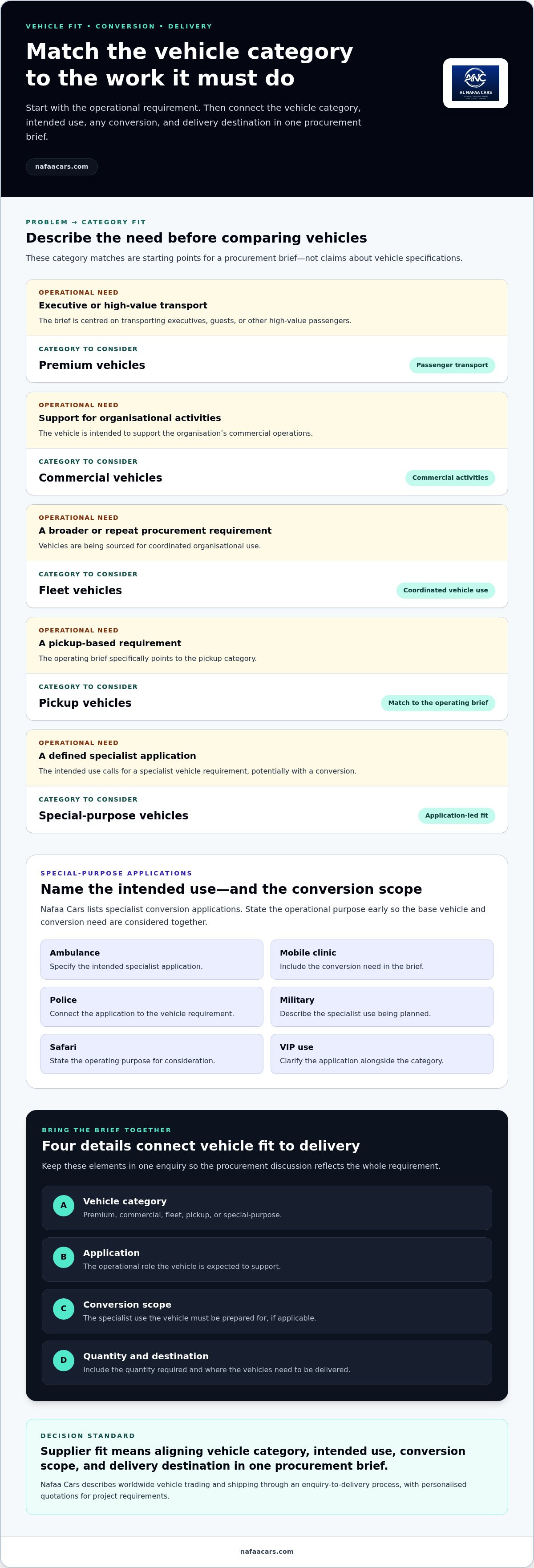
Start with the work the vehicle must perform, then identify the category that best describes the requirement. A broad catalogue can be useful, but it does not prove that a particular vehicle suits your organisation or application. Use the comparison below to shape a procurement brief. It is a starting point, not a claim about vehicle specifications.
| Buyer requirement | Vehicle category | Intended operational use |
|---|---|---|
| Executive or high-value transport | Premium vehicles | Transport for executives, guests, or other high-value passengers |
| Organisational operations | Commercial vehicles | Supporting the organisation’s commercial activities |
| Vehicles for coordinated organisational use | Fleet vehicles | Meeting a broader or repeat vehicle procurement requirement |
| Pickup-based requirement | Pickup vehicles | Use cases where a pickup category matches the operating brief |
| Defined specialist application | Special-purpose vehicles | Applications such as ambulance, mobile clinic, police, military, safari, or VIP use |
Which vehicle category fits the procurement brief?
Use the category to describe the requirement, then add the operating context. Premium vehicles may suit executive or other high-value transport. Commercial and fleet vehicles address organisational operating needs, whether the brief concerns a specific activity or a wider vehicle requirement. Consider pickup and special-purpose categories in relation to their intended applications rather than assuming they serve the same role. The Center for Automotive Research (CAR) examines automotive industry topics, including supply chains and manufacturing. Buyers still need to map their own operational requirements to a vehicle category.
For a clearer comparison, state who will use the vehicle, what function it must support, and where it will operate. This gives the supplier a useful basis for discussing category fit without relying on unsupported assumptions about a model’s capabilities.
When should conversion be part of the vehicle brief?
Include conversion in the discussion when the vehicle is intended for a specialist application. Ambulance and mobile clinic conversions share a healthcare context, but the specific application should distinguish the requirement. Police and military conversions represent different operational briefs, as do safari and VIP conversions. These labels describe the purpose of the conversion, not a specific vehicle configuration.
A useful conversion brief begins with a clearly defined vehicle use and explains how the converted vehicle is expected to serve that purpose. Define the application first, then connect it to the vehicle category. This keeps the discussion grounded in the organisation’s actual requirement instead of letting an assumed configuration drive the decision. Nafaa Cars brings vehicle trading together with specialist conversion applications. Its vehicle categories and conversion applications provide a basis for framing that combined brief.
Compare global vehicle supply models before committing
A procurement brief can cover vehicle supply alone or combine supply with a specialist conversion. The right approach depends on what the vehicle must do, not on an assumption that one model is always more efficient. Compare the options against the same project requirements to see what needs coordinating and where the scope needs to be clear.
Vehicle-only supply or vehicle plus conversion?
A vehicle-only purchase may suit a requirement where the selected vehicle category meets the intended use without specialist conversion. If the vehicle is intended for ambulance, mobile clinic, police, military, safari, or VIP use, conversion scope becomes part of the procurement decision. Discussing the base vehicle and intended application together brings both into view, while requiring the buyer to define each clearly. The operational brief determines the right route.
Bringing vehicle supply and conversion into one discussion can help keep the category, application, and destination connected in the enquiry. Describe the conversion requirement clearly enough to support a project-specific quotation. A vehicle-only brief has a narrower scope; a combined brief also accounts for the intended specialist use.
How to compare supplier scope against project needs
Assess a global vehicle supplier by matching its stated capabilities to the project. Do not infer vehicle specifications or delivery terms from a category label. Industry bodies such as AIAG (Automotive Industry Action Group) focus on automotive supply-chain collaboration and practices. For an individual procurement, the practical task is to define the required scope and compare it with the supplier’s offer.
| Requirement | What to define | What to assess |
|---|---|---|
| Vehicle type | Required category and quantity | Whether the supplier’s vehicle categories match the brief |
| Application | Operational purpose | Whether the stated conversion applications align with the use |
| Conversion | Whether a conversion is required and its intended purpose | Whether vehicle supply and conversion can be discussed together |
| Destination | Country or delivery destination | Whether worldwide shipping is within the supplier’s stated scope |
Use the matrix to separate stated scope from assumptions. For example, worldwide shipping does not by itself specify delivery timing or shipping arrangements. A vehicle category also does not establish a particular configuration. Keep those details out of the comparison unless they are addressed in the project-specific discussion.
Supplier fit depends on how the complete project brief aligns with the supplier’s vehicle categories, relevant conversion applications, and delivery scope. Nafaa Cars brings worldwide vehicle trading and shipping together with specialist vehicle conversions, and provides personalised quotations for project requirements. Use Nafaa Cars’ vehicle and conversion supply as a starting point for framing a combined enquiry.
From enquiry to delivery: how a global vehicle supplier coordinates the order
A clear enquiry gives the procurement discussion a practical starting point. When working with a global vehicle supplier, connect the vehicle requirement to its intended use, any conversion, and the delivery destination. This keeps supply and shipping within the same project context without assuming particular routes, timelines, or terms.
What to include in a vehicle supply enquiry
Organise the details so the requirement reads as a complete project. State the vehicle category, quantity, operational application, conversion scope, and destination. For a fleet, include the quantity or describe the fleet requirement alongside the category. For a specialist application, name the intended use, such as ambulance, mobile clinic, police, military, safari, or VIP, and explain the conversion need in relation to that purpose.
- Vehicle category: Identify whether the brief concerns premium, commercial, fleet, pickup, or special-purpose vehicles.
- Quantity: Include the number of vehicles or describe the fleet requirement.
- Application: State how the vehicles will be used by the organisation.
- Conversion scope: Explain the specialist application and conversion need, if relevant.
- Destination: Specify where the vehicles are to be delivered.
Keep the information direct. A brief for commercial vehicles supporting organisational operations differs from one for special-purpose vehicles with a named conversion application. Include the destination at the outset so worldwide shipping is part of the procurement discussion, not an afterthought.
How the enquiry moves towards delivery
Nafaa Cars describes its customer process as running from enquiry to delivery, with personalised quotations. The stated sequence is:
- Enquiry: Provide the vehicle category, quantity, intended application, conversion scope, and destination.
- Personalised quotation: Use the requirements in the enquiry to begin a project-specific commercial discussion through a tailored quotation.
- Delivery: Vehicle supply and worldwide shipping form part of the journey through to delivery. Keep the vehicle and any conversion requirement connected as the order progresses.
A tailored quotation is most useful when the enquiry describes the project, not just a vehicle category. Include the intended application and conversion need alongside the supply requirement, and state the destination so the discussion reflects the full brief. Worldwide shipping is part of Nafaa Cars’ offering, but that alone does not specify delivery timing, routes, or arrangements.
To begin a personalised quotation discussion, Submit a vehicle enquiry.
Work with Nafaa Cars as your global vehicle supplier
For business and institutional buyers, Nafaa Cars brings worldwide vehicle trading and shipping together with a range of vehicle categories and specialist conversion applications. Its offering addresses varied procurement briefs, from premium transport to commercial and special-purpose requirements. Start by defining the operation the vehicle needs to serve.
A vehicle and conversion scope for varied operations
Nafaa Cars supplies premium, commercial, fleet, pickup, and special-purpose vehicles. Its conversion applications include ambulance, mobile clinic, police, military, safari, and VIP use. These categories and applications help buyers describe a requirement; they do not establish that a particular model or configuration is suitable. The project brief connects the vehicle type to its intended use.
For example, a buyer planning an ambulance or mobile clinic requirement can describe the healthcare application and conversion scope in the same enquiry. A police, military, safari, or VIP brief should likewise state its purpose clearly. Defining the use first gives the procurement discussion a basis for considering the relevant vehicle category and conversion together.
A well-defined scope makes the project clearer. Rather than treating vehicle supply and specialist conversion as unrelated decisions, buyers can describe both as parts of one operational requirement. This keeps the discussion focused on the organisation’s purpose without assuming particular specifications or outcomes.
Prepare a project brief and take the next step
Before making an enquiry, assemble the details that explain what the organisation needs. A concise brief can include:
- Vehicle type: The category that best represents the requirement.
- Intended use: The operational application the vehicle must serve.
- Conversion needs: The specialist application and scope, if required.
- Quantity: The number of vehicles or the fleet requirement.
- Destination: Where the vehicles are to be delivered.
These details make the enquiry specific enough to support a personalised quotation. They also bring vehicle supply, conversion requirements, quantity, and destination into one project discussion. Nafaa Cars’ process runs from enquiry to delivery, with worldwide shipping as part of its offering. A clear brief gives the discussion a defined starting point, while the tailored quotation addresses the project requirements.
If your organisation is ready to discuss a vehicle requirement, set out the category, application, conversion needs, quantity, and destination in your enquiry. Enquire with Nafaa Cars to begin a project-specific discussion with a global vehicle supplier.
Put your procurement brief into action
Turn internal expectations into a decision-ready brief. Bring procurement teams and operational users together around what the project must achieve and where flexibility is possible. Clear priorities can reduce ambiguity during internal approvals and give the commercial discussion a practical starting point.
Use your relationship with a global vehicle supplier as a working dialogue, not simply a request for a catalogue. Identify the decisions your organisation has made, the points that still need discussion, and who needs to contribute before the project progresses. This keeps attention on the operational outcome while allowing the proposed scope to be considered against your priorities.
A well-prepared enquiry is a useful first move, even if every detail is not settled. State the requirement as clearly as possible and work through the decisions one at a time. Enquire with Nafaa Cars about your vehicle requirements to begin a project-specific conversation. With a clear brief and shared priorities, your organisation can take the next step with confidence.
Frequently Asked Questions
Is a global vehicle supplier the same as a vehicle manufacturer?
No. A manufacturer produces vehicles, while a global vehicle supplier supports buyers with vehicle trading and supply across markets. Some suppliers also provide specialist conversion work. This distinction matters if your organisation needs to consider several vehicle categories or an application-specific requirement rather than choose from one manufacturer’s catalogue. Assess whether the supplier’s stated scope covers the intended vehicle use and cross-border delivery needs.
Can one global vehicle supplier provide both vehicles and conversions?
Yes. A supplier may handle vehicle trading alongside specialist conversion work, bringing both aspects into one project discussion. Nafaa Cars offers vehicle categories and conversion applications for varied operational briefs. For example, an organisation considering a mobile clinic can describe the healthcare use and conversion requirement together, rather than treating them as unrelated decisions. Identify the intended application in the enquiry to make the project scope clear from the outset.
What information should I include when requesting a vehicle quotation?
Include the vehicle category, intended use, quantity, destination, and any conversion application. Add context about how the vehicles will be used, such as whether they are assigned to one operation or intended for use across an organisation. If requirements differ within a fleet, separate them rather than combining distinct needs in one general description. This gives the supplier a useful basis for preparing a personalised quotation around the project.
Does worldwide vehicle shipping mean delivery is available to every country?
Worldwide shipping describes an international service scope, but it should not be read as a guarantee of delivery to every destination under identical arrangements. Include the destination in your enquiry so it can be considered alongside the vehicle and any conversion requirements. Do not base internal plans on an assumed route, schedule, shipping term, or import outcome. The general description of worldwide shipping does not establish those project-specific details.
Can a global vehicle supplier support fleet or institutional buyers?
Yes. A global vehicle supplier can support organisational procurement when its categories and project scope align with the institution’s requirements. Nafaa Cars’ vehicle offering includes fleet, commercial, and special-purpose categories. For a multi-unit procurement, identify whether all vehicles serve the same purpose or whether the requirement includes distinct operational roles. This helps the enquiry present an accurate picture of the organisation’s needs and keeps the commercial discussion focused.
Which specialist vehicle conversion applications does Nafaa Cars offer?
Nafaa Cars provides conversions for ambulance, mobile clinic, police, military, safari, and VIP use. When preparing an enquiry, identify the intended application and explain how the vehicle is expected to serve it. Include the vehicle category, quantity, and destination as well, so the conversion requirement sits within the full procurement brief.


