
What if the right vehicle becomes the wrong investment because its specifications, export documents, or delivery arrangements were not aligned before shipment? Choosing a commercial vehicle exporter involves more than finding a suitable vehicle. Buyers also need to understand who handles each stage and what information must be ready.
Look beyond vehicle availability. The responsibilities of the seller, exporter, shipper, and buyer can overlap, while destination-country import requirements and incomplete paperwork can affect the plan. A structured process brings these details into focus before shipment arrangements advance.
This guide explains how vehicle sourcing, export preparation, and international shipping fit together. You’ll find practical criteria for comparing exporters and preparing a brief that covers vehicle requirements and delivery needs. Nafaa Cars supports international commercial requirements through vehicle trading, professional conversions, and worldwide shipping, with a process that runs from enquiry to delivery.
Key Takeaways
- Separate the exporter’s coordination role from the responsibilities of the seller, carrier, customs broker, and importing buyer.
- Plan the export process from enquiry through delivery, and prepare relevant information at each stage.
- Compare a commercial vehicle exporter by vehicle fit, conversion capability, export coordination, shipping scope, and communication.
- Build a concise vehicle brief covering its intended use, category, quantity, destination, and delivery needs.
- Explore how Nafaa Cars’ commercial, fleet, pickup, and special-purpose vehicles can support different organizational requirements.
What Does a Commercial Vehicle Exporter Do?
A commercial vehicle exporter coordinates the cross-border trade and export arrangements for vehicles intended for business, institutional, or specialist use. The role connects the vehicle transaction with preparation for departure and the transport plan. The exporter may coordinate several parts of the process, but the exact division of work depends on the transaction.
A commercial vehicle exporter aligns the vehicle transaction, export preparation, and transport arrangements so a buyer can move a suitable vehicle across borders with responsibilities clearly defined.
That coordination matters because a commercial vehicle is procured for a job, not simply for transport. Vehicle configuration, intended operation, paperwork, shipping arrangements, and the receiving destination all need to fit together. Export requirements vary by route, so a rule that applies to one origin or destination should not be treated as universal.
Exporter, seller, and freight forwarder: who does what?
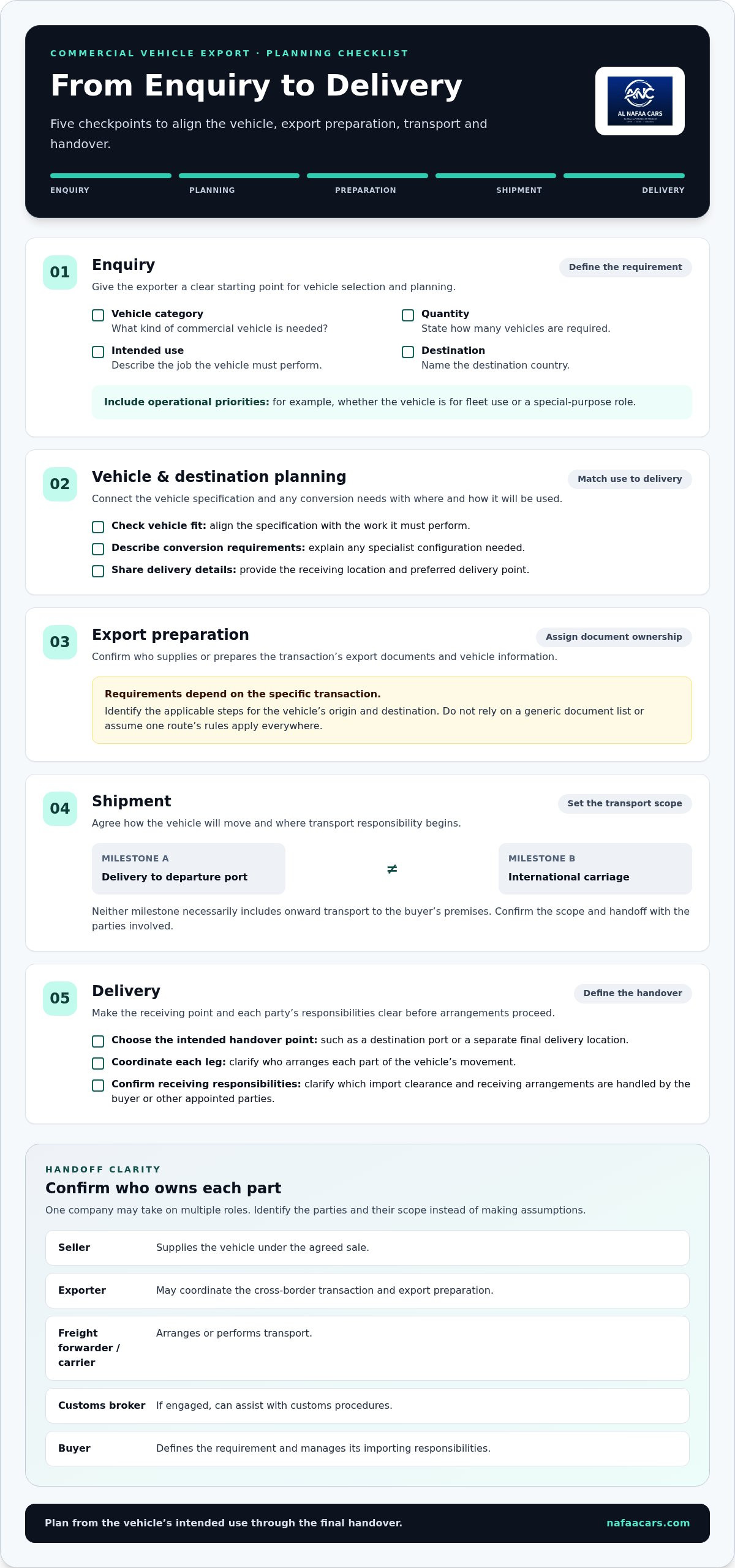
The seller supplies the vehicle under the agreed sale. An exporter may coordinate the cross-border transaction and export preparation. A freight forwarder or carrier arranges or performs transport, while a customs broker, if engaged, can assist with customs procedures. The buyer defines the requirement and manages its importing responsibilities. One company may take on multiple roles, so identify the parties and their scope rather than making assumptions.
Before shipment planning advances, establish who is responsible for vehicle details, export paperwork, transport booking, and import clearance. The exporter can coordinate the process, but that does not automatically make it the seller, physical carrier, customs authority, or importer of record. Clear responsibility boundaries help prevent gaps, such as each party assuming someone else has supplied a document or arranged a handover.
Define the destination and receiving point early, then clarify how import procedures will be handled. The exporter and other appointed parties can work from that agreed scope. Because requirements differ between jurisdictions, treat country-specific steps as part of the transaction plan rather than relying on a universal export checklist.
Why commercial vehicle exports need operational planning
Start with the work the vehicle must perform. A fleet vehicle for routine operations has a different purpose from a special-purpose vehicle intended for ambulance or mobile clinic use. The operating environment and deployment needs help determine the base vehicle category and any conversion requirements. Defining the use before procurement reduces the risk of arranging transport for a vehicle that does not meet the organization’s needs.
Destination and delivery details also shape the plan. The receiving location, handover point, and any requirements for handling or onward movement affect how the shipment is organized. A clear brief gives the exporter and transport parties a shared basis for coordinating preparation and delivery. Nafaa Cars supports international vehicle trading and professional conversions, with a process from enquiry to delivery and worldwide shipping.
How Commercial Vehicle Export Works from Enquiry to Delivery
A well-managed export process moves through defined stages, with the buyer supplying clear information before each handoff. Tasks and documents depend on the vehicle, transaction, origin, and destination. Use the sequence below as a planning framework, not a universal checklist.
- Enquiry: Describe the vehicle category, quantity, intended use, and destination. Include operational priorities, such as whether the vehicle is for fleet use or a special-purpose role.
- Vehicle and destination planning: Match the vehicle specification and any conversion requirements to the work it must perform. Share the destination country, receiving location, and preferred delivery point so transport and import considerations can be planned together.
- Export preparation: Confirm which party will prepare or supply the transaction’s export documents and vehicle information. Requirements vary, so identify the applicable steps for the specific origin and destination instead of relying on a generic document list.
- Shipment: Agree how the vehicle will move and where transport responsibility begins. Delivery to a departure port is a different milestone from international carriage, and neither necessarily includes onward transport to the buyer’s premises.
- Delivery: Define the intended handover point, such as a destination port or a separate final delivery location. Clarify who coordinates each leg and which import clearance or receiving arrangements are handled by the buyer or other appointed parties.
What happens after the initial vehicle enquiry?
A clear enquiry gives the commercial vehicle exporter a practical basis for vehicle selection and conversion discussions. State what the vehicle must do, how many are required, where they will operate, and where they need to be delivered. For example, a mobile clinic conversion enquiry should describe the intended deployment. The destination and handover point help frame export and transport planning.
Before arrangements proceed, align the vehicle requirements with the destination and delivery scope. This gives the buyer and the parties coordinating the transaction a shared reference without assuming that every export follows the same milestones or contractual terms.
Which export documents and regulatory steps may apply?
Documentation and customs procedures depend on the origin, destination, vehicle, and transaction. No single international document list applies to every shipment. Identify the authorities responsible for the route and verify current requirements before finalizing shipment planning. The Electronic Code of Federal Regulations’ U.S. export regulations for vehicles are an example of country-specific rules, not a global standard.
For U.S.-related exports, consult applicable guidance from U.S. Customs and Border Protection alongside the regulation. For other routes, use the requirements issued by the relevant origin and destination authorities. Record who is preparing each required item and who is responsible for import clearance. Export preparation does not automatically include destination-side procedures.
Nafaa Cars’ process runs from enquiry to delivery, supported by worldwide shipping and vehicle trading. Buyers preparing an international commercial vehicle enquiry can use Nafaa Cars’ vehicle trading and conversion services to start defining the vehicle and delivery brief.
How to Compare Commercial Vehicle Exporters
A useful comparison looks beyond whether a vehicle appears available. Assess how well each commercial vehicle exporter can align the vehicle category, required conversion, export coordination, shipping scope, and communication with your organization’s needs. Separate stated capabilities from assumptions. Worldwide shipping, for example, does not establish a particular route, delivery time, or division of contractual responsibility.
Use the same criteria for each option so the comparison reflects operational fit:
Vehicle fit: Compare the vehicle categories with the intended work. Nafaa Cars offers commercial, fleet, pickup, and special-purpose vehicles.
Conversion capability: If the application requires a purpose-built configuration, consider whether the relevant conversion is offered. Nafaa Cars lists ambulance, mobile clinic, police, military, safari, and VIP vehicle conversions.
Export coordination: Look for a clearly described process from enquiry through delivery. Nafaa Cars states that its process runs from enquiry to delivery.
Shipping scope: Distinguish a stated worldwide shipping capability from assumptions about specific routes, transport modes, or final-mile arrangements.
Communication: Consider whether vehicle requirements, destination details, delivery points, and party responsibilities are addressed clearly and consistently.
These criteria help distinguish a defined service scope from an expectation that may not be included in the arrangement. A broad description alone does not establish a specific shipping route, schedule, or contractual obligation. The scope should connect the vehicle and destination to a defined handover point.
Which capabilities matter for a commercial vehicle order?
Start with the work the vehicle must perform, then match its category to that requirement. A fleet order, pickup requirement, or specialist application may need different vehicle and conversion capabilities. Conversion options matter when the vehicle must serve a defined role, such as ambulance or mobile clinic use. Also assess how clearly the process is explained from initial enquiry through delivery.
How can buyers assess shipping and compliance coordination?
Look for a clear distinction between export preparation, transport coordination, and destination-side import procedures. Origin-country rules and destination requirements are separate considerations, and responsibility for each should be stated rather than inferred. Apply one comparison principle throughout: evaluate scope, responsibility, and destination fit together. An arrangement is not clear if its handover point or the party accountable for a task is undefined.
For an objective review, note what is explicitly included, what remains an assumption, and where responsibility passes between parties. Nafaa Cars brings global vehicle trading, professional conversions, and worldwide shipping together for international commercial requirements, with vehicle categories suited to varied organizational needs.
Prepare a Commercial Vehicle Export Brief Before Shipment
A structured brief turns an operational requirement into information that can guide vehicle selection, conversion discussions, and export planning. It also separates decisions already made from questions that still need resolution. For a commercial vehicle exporter, this clarity supports a more consistent handoff between procurement, vehicle preparation, and delivery coordination.
Define the vehicle’s operational role and configuration
Begin with the work the vehicle must perform and the environment where it will be deployed. Describe its role in practical terms, such as transporting a team, supporting fleet operations, or serving as a mobile clinic. The intended use helps determine whether a standard commercial vehicle is appropriate or whether to consider a special-purpose conversion.
Include these core details in the brief:
- Use and deployment: State the vehicle’s primary role, operating context, and work-specific requirements that may affect configuration.
- Vehicle category: Identify whether the requirement is for a commercial, fleet, pickup, or special-purpose vehicle. Describe essential needs without assuming a particular model or technical specification.
- Quantity and consistency: Specify the number of vehicles and whether they need consistent configurations across a fleet. Record any variations between units.
- Conversion needs: Describe the intended application and functions for any conversion, such as ambulance or mobile clinic use. Separate essential features from preferences still under consideration.
Be explicit about what is settled and what remains open. For example, a buyer may have defined the vehicle’s role and quantity but still be deciding between a standard configuration and a conversion. Labeling that as an open decision keeps the brief useful without turning an assumption into a fixed specification.
Set destination, documentation, and delivery parameters
Export planning needs a defined destination, not only a country name. Note the intended delivery point, such as a port or separate receiving location, and describe the handover the organization requires. This helps identify where international transport ends and whether onward delivery is part of the plan.
Add route-specific questions for verification. Import requirements depend on the destination and transaction, so verify current rules with the relevant authorities. Export-side preparation does not mean destination import procedures have been completed.
- Name the destination country and intended delivery or handover point.
- Record known documentation questions and identify which authority or party must clarify them.
- Separate confirmed requirements from unresolved details, including import steps and delivery arrangements.
- Note who will coordinate export preparation, transport, and destination-side clearance.
A well-defined brief gives vehicle sourcing and delivery planning a shared reference point. To discuss a commercial vehicle requirement with Nafaa Cars, Discuss your commercial vehicle requirements.
How Nafaa Cars Supports Worldwide Commercial Vehicle Enquiries
International commercial procurement brings vehicle requirements and delivery planning into the same conversation. Nafaa Cars provides global vehicle trading and worldwide shipping for organizations sourcing vehicles across borders. Its process runs from enquiry to delivery, giving buyers a starting point for discussing their requirements and delivery needs.
Begin with a clear use case. A vehicle’s intended role helps frame whether the requirement is for general commercial operations, a fleet, pickup use, or a special-purpose application. This also helps buyers communicate which elements are essential and where a conversion may be relevant.
Vehicle trading and conversion options for organizations
Nafaa Cars offers commercial and fleet vehicles for organizational procurement, alongside pickup and special-purpose categories. Its listed conversion applications include ambulance, mobile clinic, police, military, safari, and VIP vehicles. Defining the intended application gives a conversion discussion a practical foundation: describe the work the vehicle must support, its deployment context, and the key functions the organization requires.
A conversion brief should distinguish operational needs from preferences. For example, an organization considering a mobile clinic vehicle can state its service role and deployment context, then identify which configuration questions still need development. This keeps the enquiry focused on purpose rather than assuming a particular model or specification. The same discipline applies to fleet orders, where consistency between vehicles may be a central procurement consideration.
Move from a defined requirement to an enquiry
Bring the core procurement details together before starting the enquiry: vehicle category, intended use, quantity, destination country, and preferred delivery point. Add any special-purpose conversion needs and note which decisions remain open. This concise summary gives the discussion a practical reference and connects vehicle requirements with international delivery planning.
Nafaa Cars’ process runs from enquiry to delivery. Its worldwide shipping supports international vehicle requirements, while its vehicle trading and professional conversion offerings connect organizational needs with relevant vehicle categories. Frame the discussion around the operational brief and destination so the vehicle and delivery requirements are clear.
For procurement teams, a well-prepared enquiry makes the vehicle’s role, destination, and conversion considerations clear from the outset. Share those requirements to begin a discussion about commercial or fleet vehicles and relevant special-purpose applications.
Enquire about commercial vehicles with Nafaa Cars.
Turn Your Export Plan into a Clear Enquiry
Turn procurement priorities into a defined requirement. Decide which needs are fixed, where flexibility remains, and what the receiving team will need at handover. This gives a commercial vehicle exporter a practical basis for discussing vehicle fit and delivery scope, while helping your organization make decisions with fewer assumptions.
Nafaa Cars brings global vehicle trading and worldwide shipping together with commercial, fleet, and special-purpose vehicle offerings. For organizations planning an international purchase, a focused enquiry connects the vehicle’s intended role with the destination and delivery requirements.
Prepare the key details: vehicle category, intended use, quantity, destination, and any conversion needs. Then share your commercial vehicle and delivery requirements with Nafaa Cars to begin the enquiry process. A clear brief is a practical first step toward an export plan built around your organization’s needs.
Frequently Asked Questions
What documents are needed to export a commercial vehicle?
There is no single document set for every commercial vehicle export. The vehicle’s origin, destination, ownership status, and transaction details can affect what is required. Documentation may relate to ownership, sale, transport, or customs procedures. Verify current requirements for the specific route with the relevant authorities, then map each requirement to the party responsible for supplying it. Do not treat an example from one country as a universal checklist.
How long does it take to export a commercial vehicle?
Export timing depends on the vehicle’s readiness, any required preparation or conversion, transport scheduling, and destination procedures. Request a timeline with separate stages, such as preparation, departure, international transit, and arrival handling. This makes it easier to distinguish planned steps from those that depend on external schedules. A project involving a conversion should account for that work before assessing shipment timing.
Can a commercial vehicle exporter arrange worldwide shipping?
International shipping arrangements depend on the specific transaction. Nafaa Cars promotes worldwide shipping as part of its global vehicle trading activity. Distinguish the destination port from the final receiving location and define the handover point your organization needs. This clarifies the shipping plan without assuming a particular route or delivery arrangement.
Are export requirements the same in every country?
No. Applicable procedures can differ according to the origin country, destination, vehicle, and transaction. U.S. Customs and Border Protection guidance, including 19 CFR Part 192, applies to relevant U.S. exports and is not a global rulebook. For shipments involving other countries, consult the authorities responsible for that route. Confirming both export and import requirements helps avoid relying on rules that apply only elsewhere.
Should I choose a standard commercial vehicle or a converted vehicle?
Choose based on the work the vehicle must perform, not on category alone. A standard commercial vehicle may suit general transport, while a defined specialist role may call for a conversion. For example, an organization planning mobile clinic operations should first describe the intended service and deployment conditions. Use those needs to distinguish essential conversion functions from preferences, then consider suitable commercial, fleet, or special-purpose vehicle options.
What should I include in an enquiry to a commercial vehicle exporter?
Include the vehicle’s intended role, category, quantity, destination country, and required handover point. If a conversion is relevant, describe its purpose and the functions the vehicle must support. Add known route or import questions, but label unresolved matters as open decisions rather than fixed specifications. This gives the exporter a useful starting brief and focuses the discussion on vehicle fit, scope, and the information needed to develop the requirement.


