
The right commercial vehicle isn’t necessarily the largest or most powerful option. It’s the one that fits the work. Commercial vehicles for sale can be difficult to compare because categories, configurations and specifications vary. A vehicle that looks suitable on paper may still fall short if its capacity or configuration does not match daily duties and operating conditions.
Start by defining the job, then compare options against consistent operational criteria. This guide explains how to assess vehicle categories, review specifications and prepare a procurement brief before making an enquiry. It also covers conversion requirements and international delivery planning. Whether you need a commercial, fleet or pickup vehicle, or a special-purpose vehicle such as an ambulance or mobile clinic, the principle is the same: match the vehicle to its duty, then align its specification, conversion and delivery. Nafaa Cars provides worldwide vehicle trading and shipping through a process that runs from enquiry to delivery.
Key Takeaways
- Define the vehicle’s daily duties first to narrow the commercial vehicles for sale that merit comparison.
- Assess body configuration and capacity against the load and work the vehicle must handle.
- Compare condition and configuration separately, then weigh their practical trade-offs for your operation.
- Prepare a concise procurement brief with intended use, vehicle category, required capacity, quantity and destination.
- A clear brief supports a structured enquiry-to-delivery process for commercial, fleet, pickup and special-purpose vehicles.
Commercial Vehicles for Sale: Start with the Work the Vehicle Must Do
A commercial vehicle is selected or configured to support work or organisational operations. It may transport people, goods or equipment, or serve a defined operational role. The broader commercial vehicle definition covers a range of vehicle types and uses. For procurement, start with the specific job the vehicle must perform.
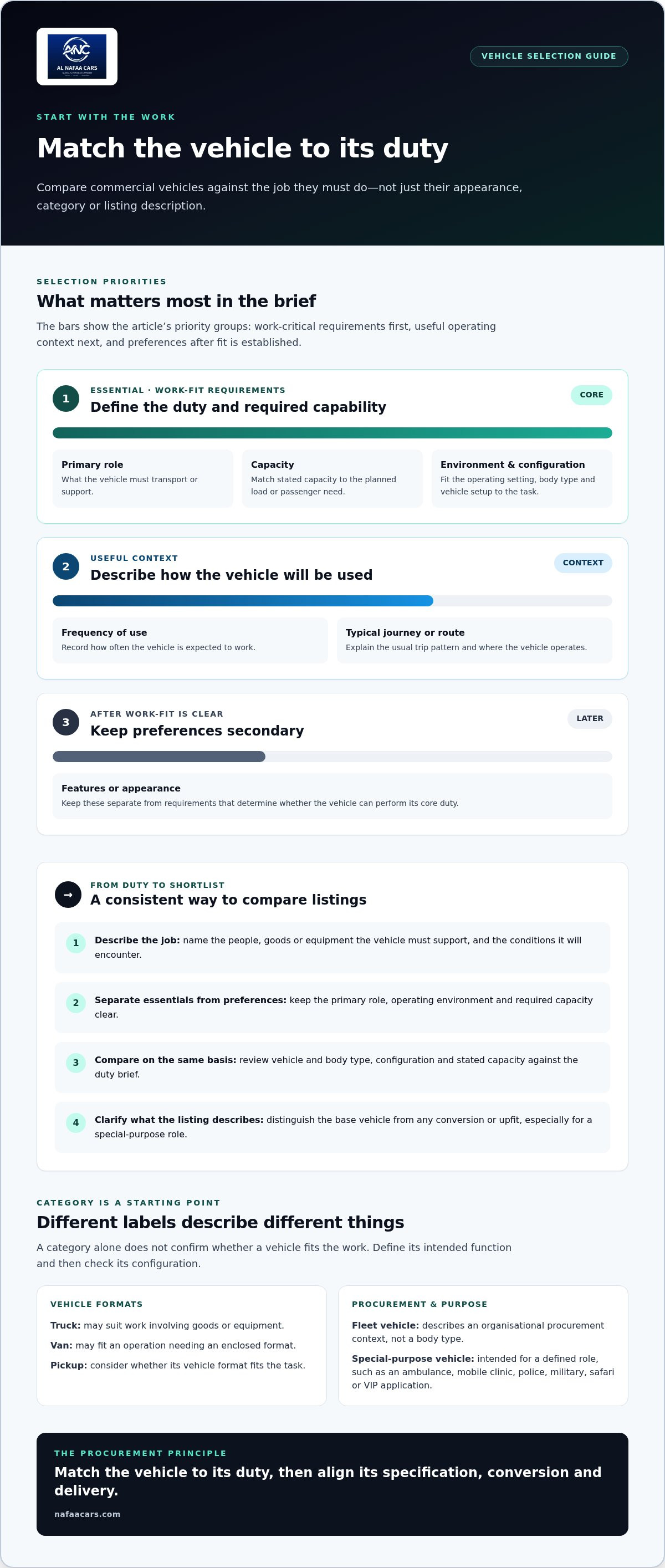
Define the duty before choosing a make, appearance or listing category. Those details can help narrow a shortlist, but they do not show whether a vehicle is fit for the work. Describe what it needs to carry or support, how it will be used and the conditions it will encounter. Then compare commercial vehicles for sale against those requirements. This gives everyone involved in procurement a shared basis for evaluating options.
For example, a team moving equipment between work sites may need a different vehicle from an organisation transporting staff on regular journeys or moving goods along a planned route. The label “commercial vehicle” does not distinguish those duties. A useful description states what the vehicle supports, where it operates and what a typical working day involves. Use that context to assess capacity and configuration.
Which commercial vehicle categories serve different operations?
Trucks and vans are broad categories, not complete specifications. A truck may suit work involving goods or equipment, while a van may fit an operation that needs an enclosed format. The right configuration depends on the duty. A pickup may suit work where its particular vehicle format fits the task. “Fleet vehicle” describes an organisational procurement context, while “special-purpose vehicle” refers to a vehicle intended for a defined role. These terms do not all describe body types.
Some duties call for a purpose-specific conversion rather than a general transport role. Examples include ambulance, mobile clinic, police, military, safari and VIP applications. Treat the category as a starting point and explain the function the vehicle must perform. A clear description helps distinguish the broad vehicle class from the configuration or conversion the operation actually needs.
How should buyers describe the vehicle’s intended duty?
Build the description around everyday use. Identify the people, goods or equipment the vehicle must support, the operating environment, how often it will be used and what a typical journey involves. Separate essential requirements from preferences. This keeps the initial brief focused and leaves secondary choices for later.
- Essential: the vehicle’s primary role, operating environment and required capacity.
- Useful context: frequency of use and the typical journey or route pattern.
- Preferences: features or appearance choices that do not determine whether the vehicle can perform its core duty.
Be specific. “Transport equipment between work sites on a regular basis” gives a clearer starting point than “a versatile vehicle.” Refine the brief as you compare specifications, but use the operational purpose as the reference point throughout procurement.
How to Read Commercial Vehicle Specifications Before Comparing Listings
Use the duty brief as your comparison standard. A listing describes a vehicle, but its details matter only in relation to the planned work. For each candidate, compare the body type, configuration and stated capacity with the people, goods or equipment the vehicle must support. This prevents a vehicle from seeming suitable just because it looks like another option.
Compare stated capacity with the workload the vehicle is expected to carry or support. If the planned load exceeds the stated capacity, the vehicle may not meet the requirement. If its capacity is substantially greater than the duty calls for, weigh that against your other priorities. Treat capacity as a core selection criterion, not a detail to revisit after choosing a vehicle.
Which vehicle details deserve attention in a listing?
Start with the details that directly match your brief: vehicle and body type, configuration, and stated capacity. Compare these on the same basis across listings. A vehicle described for passenger use may not be a direct alternative to one described for carrying goods or equipment, even if they look similar.
Check whether the description refers to the vehicle itself, a conversion or an upfit. It may cover the base vehicle, a modified configuration, or both. For a special-purpose role, identify what the description says about the completed vehicle and the function it is intended to support. Do not assume that vehicles with similar appearances have equivalent capabilities.
How do operating conditions affect specification priorities?
Route and work setting affect which details matter most. Regular journeys between work locations, use in a defined work environment and frequent passenger transport can each lead to different requirements. Record how often the vehicle will be used and whether its primary role is to support people, cargo or equipment. This helps separate essential capability from preference.
Before comparing commercial vehicles for sale, mark the non-negotiable requirements in your duty brief and keep optional preferences separate. For example, put a required body format or capacity in the essential group when the work depends on it. Consider appearance preferences only after identifying suitable candidates.
- Match: body type and configuration to the vehicle’s intended role.
- Compare: stated capacity with the planned load or passenger requirement.
- Clarify: whether details refer to the vehicle, a conversion or an upfit.
- Prioritise: essential operational needs before secondary preferences.
This approach makes comparisons more consistent and prevents listing language from driving the decision. For organisations assessing commercial and special-purpose vehicle options, a written duty brief is a practical starting point for an enquiry.
Compare Commercial Vehicle Options by Condition, Configuration, and Purpose
Compare each candidate on three separate points: whether its condition suits the procurement requirement, whether its configuration fits the work, and whether it is intended for the right purpose. These factors affect one another, but they are not interchangeable. A suitable configuration does not establish that the vehicle’s condition meets your requirements. Likewise, a preferred condition cannot make an unsuitable configuration right for the job.
Whether to choose a new or used vehicle depends on the sourcing requirement. Consider how the vehicle will be used, what condition information is available for each candidate, and which factors your organisation has prioritised. Compare documented details consistently rather than ranking options by age or appearance alone. The right choice is the one that aligns with the duty brief and procurement criteria.
Use a comparison table to keep the decision focused:
| Intended duty | Condition | Configuration | Key trade-offs |
|---|---|---|---|
| Transport goods | Compare the documented condition of each candidate | Assess the body format against the load and working routine | Balance operational fit with the condition priorities in the brief |
| Move people or equipment | Review condition information consistently | Consider the layout and intended use | Prioritise the required function over secondary preferences |
| Specialist operation | Compare details for the vehicle being considered | Distinguish a standard vehicle from a converted application | Account for the purpose the completed vehicle must serve |
How should buyers compare new and used options?
Begin with expected use and your organisation’s priorities. Apply the same method to every candidate: record the condition details available, configuration and intended role, then assess each against the same requirements. This keeps the comparison anchored to the work rather than to an individual feature.
Separate documented information from assumptions. Similar descriptions or outward appearances do not establish equivalent condition or suitability. Record what is documented for each vehicle and how it relates to the duty brief. This makes the comparison easier to review with procurement colleagues and helps prevent one attribute from deciding the selection by default.
When might a standard vehicle or conversion be relevant?
A standard vehicle may suit an established duty that does not require a specialist fit-out. A conversion is relevant when the operation calls for a defined application beyond general transport. Nafaa Cars provides conversion solutions for ambulances, mobile clinics, police, military, safari and VIP use. These applications have different operational purposes, so identify the one your organisation needs.
Assess condition separately from configuration and intended use. In a shortlist of commercial vehicles for sale, this three-part comparison shows where candidates meet the brief, where they differ and which trade-offs need attention before procurement moves forward.
Build a Commercial Vehicle Procurement Brief Before You Enquire
A concise procurement brief turns an operational requirement into useful information for an enquiry. It also gives colleagues a shared reference when reviewing options. Record the details that determine suitability first, then separate them from preferences to consider after identifying appropriate candidates.
What information belongs in the initial vehicle brief?
Use this sequence to build a practical brief. Make each item specific to the organisation’s intended use, and identify which requirements are mandatory and which remain open for discussion.
- Define the intended use. State the vehicle’s primary role and the people, goods or equipment it must support. Include the operating environment and typical pattern of use.
- Name the vehicle category. Indicate whether the requirement is for a commercial vehicle, pickup, fleet vehicle or special-purpose application. For a specialist role, describe the intended function, such as ambulance or mobile clinic use.
- State the required capacity. Describe the capacity needed for the planned workload, using measures relevant to your operation. Keep this requirement separate from optional preferences.
- Set the quantity. Clarify whether the enquiry is for an individual vehicle or a fleet requirement, and record the quantity needed for planning.
- Identify the destination. Name the intended destination and record known delivery constraints that affect procurement planning. Treat destination-specific considerations as buyer requirements, not assumptions about rules or procedures.
How can buyers make options easier to compare?
Apply the same criteria to every candidate. A comparison sheet can include intended use, category, required capacity, quantity, destination, condition and configuration. Record the information available for each option and mark any gaps clearly. A gap is a point to resolve in the next discussion, not a reason to rely on an assumption.
Rank requirements by operational importance. Mandatory criteria determine whether an option belongs on the shortlist; preferences help distinguish between candidates that already meet the core brief. This avoids treating unrelated features as equally important and gives procurement colleagues a clear basis for discussing trade-offs and open decisions.
- Mandatory: requirements essential to performing the intended duty.
- Preferred: attributes that would be useful but do not determine basic suitability.
- Open: details that need discussion before a decision can be made.
Before sending the brief, check that it includes the intended use, vehicle category, capacity, quantity and destination. This structure helps organise an enquiry for commercial vehicles for sale and makes options easier to review. Nafaa Cars’ process runs from enquiry to delivery, with worldwide vehicle trading and shipping. Submit your vehicle procurement enquiry with the operational details that will shape the requirement.
From Enquiry to Delivery: Nafaa Cars’ Commercial Vehicle Approach
A defined procurement brief gives a commercial vehicle enquiry a clear operational and delivery context. It connects the organisation’s intended use with the relevant vehicle category, whether the requirement is for a commercial, fleet, pickup or special-purpose vehicle. The destination also matters when planning international sourcing. Nafaa Cars trades vehicles worldwide, with worldwide shipping and a process that runs from enquiry to delivery.
The process moves from the buyer’s requirements to vehicle trading and delivery. Providing clear details at the outset keeps the enquiry focused on the work the vehicle must support, rather than unrelated preferences.
What happens after a commercial vehicle enquiry?
The procurement brief provides the context for the vehicle requirement. A high-level sequence is:
- Enquiry: The buyer outlines the intended duty, vehicle category, quantity and destination.
- Vehicle requirement: The enquiry describes the need for a commercial, fleet, pickup or special-purpose vehicle, including any stated application.
- Trading and delivery: The process continues from vehicle trading through to delivery, with worldwide shipping as part of Nafaa Cars’ service.
This sequence helps you prepare for the enquiry; it does not set particular milestones or timing. Providing the destination and known delivery constraints gives the requirement useful logistical context without relying on assumptions about destination-specific rules.
When should buyers discuss a special-purpose requirement?
Include a specialist application in the initial enquiry so the vehicle’s intended role is clear from the outset. Nafaa Cars provides conversion solutions for ambulances, mobile clinics, police, military, safari and VIP use. Describe the application, the people or activities it must support, and the operational requirements that matter to your organisation. Focus on the purpose rather than assuming technical specifications or performance outcomes.
This separates a special-purpose vehicle requirement from a general commercial or fleet need. It also gives the enquiry a clear basis for discussing the appropriate vehicle category and conversion application.
What is the next step for prospective buyers?
Before submitting an enquiry, bring together four essentials: vehicle category, intended duty, quantity and destination. Add required capacity and any specialist application where relevant. Separate mandatory requirements from preferences, and note open decisions for discussion. A well-organised brief clearly presents the procurement need, whether you are sourcing one vehicle or a broader fleet.
For organisations considering commercial vehicles for sale, the next step is to share the operational requirement with Nafaa Cars. Submit a commercial vehicle enquiry with your vehicle category, intended duty, quantity and destination.
Move Your Vehicle Requirement Forward
A procurement decision is easier to advance when the people responsible for operations, purchasing and delivery agree on the priorities. Align on which requirements are essential, who will assess the options and what information decision-makers need. This keeps internal discussions focused and prevents preferences from obscuring the vehicle’s operational purpose.
Use that alignment to turn your shortlist into a clear next step. For organisations considering commercial vehicles for sale, a well-prepared enquiry sets the direction for a focused procurement discussion. Nafaa Cars works with commercial, fleet, pickup and special-purpose vehicle requirements, including conversions for defined operational applications.
When your requirements are ready, submit your commercial vehicle enquiry to begin the discussion. A clear brief gives the process a practical starting point and helps your organisation move forward with defined procurement priorities.
Frequently Asked Questions
What does payload capacity mean in a commercial vehicle listing?
Payload capacity is the weight a vehicle is designed to carry, including the load placed in or on it. Equipment, materials and other cargo all contribute to the payload. Compare the stated figure with the weight of a typical working load, not just the main item being transported. Payload is distinct from towing capacity, which refers to a separate capability and should not be treated as an equivalent measure.
What is a cab-chassis commercial vehicle?
A cab-chassis vehicle combines the driver’s cab with a chassis frame, leaving the rear section available for a body or application suited to the intended work. This format can be relevant when the operation calls for a particular rear-body arrangement rather than a complete standard body. In a procurement brief, describe the intended use and body requirement clearly, and distinguish the cab-chassis itself from any body or conversion discussed in a vehicle description.
Can a commercial vehicle be used for personal purposes?
Yes, a commercial vehicle can be used personally, provided the use is suitable for the vehicle and consistent with applicable requirements. A vehicle selected for work may have a format, interior or operating profile that differs from personal-use priorities. Before using one privately, consider how the intended use affects your organisation’s vehicle policies, insurance arrangements and record-keeping. The specific requirements depend on the jurisdiction and the circumstances of use.
Do I need a special licence to drive a commercial vehicle?
Not always. The licence required depends on factors such as the vehicle, its weight classification, how it is used and the rules where it will be driven. A light commercial vehicle may be treated differently from a larger truck or a vehicle used for a regulated transport activity. Before assigning a driver, identify the vehicle’s classification and consult the applicable licensing authority’s requirements for that jurisdiction.
Can Nafaa Cars arrange vehicle financing?
Vehicle financing is a separate part of the purchasing process from vehicle trading and professional conversions. When enquiring about commercial vehicles for sale, specify the vehicle category and operational requirement so the discussion can focus on the vehicle procurement. Your organisation can handle funding arrangements as a separate purchasing consideration and apply its own criteria for evaluating how an acquisition will be funded.
Does Nafaa Cars provide commercial vehicle maintenance?
Vehicle maintenance is a separate operational consideration from vehicle procurement. Nafaa Cars focuses on commercial, fleet, pickup and special-purpose vehicle trading, alongside professional conversions for defined applications. When assessing a vehicle for organisational use, include maintenance planning in your broader fleet or asset-management process, taking account of how the vehicle will be used and the procedures your organisation follows to manage its vehicles over time.


