
What if the right vehicle choice starts not with a model, but with the mission it must support? For organizations, translating real operating needs into a clear brief can be difficult, especially when departments prioritize different capabilities. A well-defined brief makes specialized vehicles for organizations easier to assess against users, tasks, and operating conditions.
Broad requirements can lead to unclear specifications and complicate sourcing or conversion decisions. Start with the work the vehicle must perform, who will use it, and where it will operate. Then turn those priorities into practical requirements your team can compare, approve, and communicate.
This guide explains how to build an organization-specific vehicle brief, compare applications such as ambulance, mobile clinic, police, military, safari, and VIP vehicles, and understand the route from enquiry to delivery. Nafaa Cars provides vehicle trading and conversion solutions for these applications, with worldwide vehicle trading and shipping.
Key Takeaways
- Begin with the operational mission, then define who will use the vehicle and where it must operate.
- Separate essential requirements from preferences to create a focused brief that supports clear decisions.
- Compare healthcare, public safety, military, safari, and VIP applications by mission, users, and operating environment.
- Use one shared brief to document priorities, open decisions, and information needed for internal approval.
- Assess specialized vehicles for organizations against operational needs, then move through enquiry, project discussion, personalized quotation, and delivery.
Why organizations use specialized vehicles for distinct operational missions
A vehicle is specialized when it is selected or adapted to perform a defined organizational function. Its role depends on the work it must support, the people who will use it, and the conditions in which it will operate. The label alone does not tell you what equipment or capabilities the vehicle includes.
These details give teams a shared basis for planning. A vehicle intended to support mobile healthcare, for example, has a different organizational role from one used for passenger transport. Before comparing vehicle categories, clarify the service, users, and operating context. That makes specialized vehicles for organizations easier to assess against practical needs instead of assumptions about what a category includes.
What makes a vehicle specialized for an organization?
A specialized vehicle is selected or adapted to perform a defined organizational function. Its intended mission influences its role and configuration, but the term does not specify particular equipment or capabilities. The general concept of a special purpose vehicle provides useful background. An organizational brief adds the essential context: who needs the vehicle, what work it must support, and where it will be used.
That context matters because different teams can use similar vehicle categories for distinct purposes. Describe the task before discussing specifications. This helps decision-makers separate essential operating needs from preferences and gives internal stakeholders a shared reference for sourcing or conversion discussions.
Which organizational missions may require a dedicated vehicle?
Start with the service purpose, not the vehicle name. Nafaa Cars provides vehicle conversions for a range of organizational applications, including:
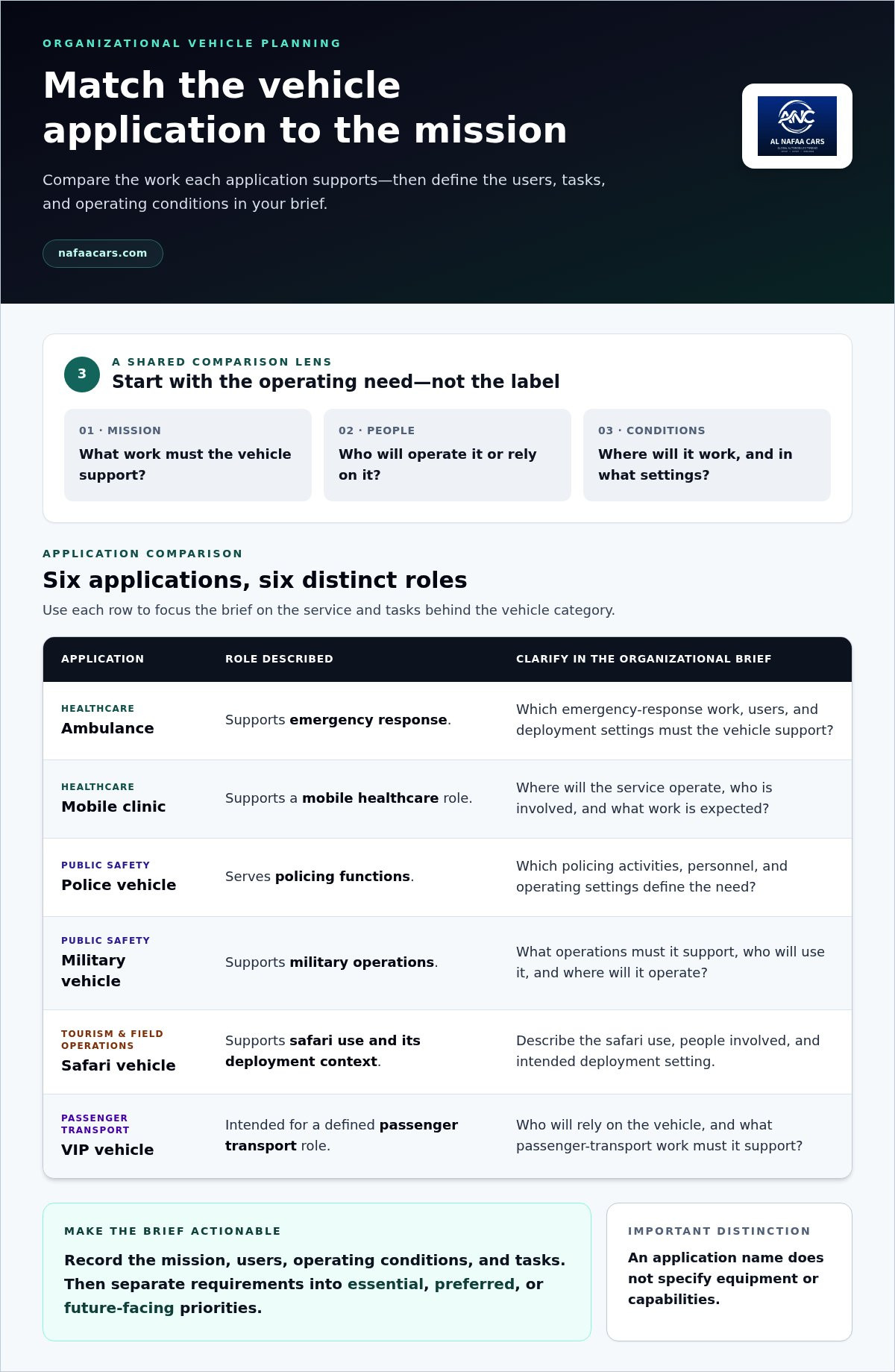
- Healthcare: ambulance and mobile clinic applications support emergency response and mobile healthcare roles.
- Public safety: police vehicles serve policing functions, while military vehicles support military operations.
- Passenger transport: VIP vehicles are intended for a defined passenger transport role.
- Tourism and field operations: safari vehicles support safari use and its deployment context.
These categories identify broad applications, not specific equipment or conversion specifications. Describe the work behind the category. For example, clarify whether the vehicle will support emergency response, deliver mobile healthcare, serve policing activity, or transport VIP passengers. This keeps planning grounded in the organization’s function rather than assumptions about a label.
For each proposed use, record who will operate or rely on the vehicle, where it will work, and what tasks it must support. Those points form the basis for setting requirements. A clear foundation helps your team explain the need and compare options without treating an application name as a complete specification.
How to translate an organization’s mission into vehicle requirements
A useful vehicle brief converts a broad objective into information decision-makers can act on. Document the service, users, operating context, and priorities before choosing a vehicle category or discussing a conversion. This gives operational teams, procurement staff, and approvers one shared reference point.
Define the mission, users, and day-to-day work
Begin by stating the service the vehicle will support and the people who will operate or rely on it. Describe typical journeys, deployment settings, and tasks during use. For example, an organization planning mobile healthcare can document where the service operates, who travels as part of it, and what work the vehicle is expected to support. This describes the need without assuming a particular layout or equipment.
Assign ownership as well. Identify who will assemble the brief and which stakeholders will approve its operational priorities. A clear owner can gather input across departments and distinguish agreed requirements from individual preferences. This is particularly useful when users, managers, and procurement teams approach the same vehicle need from different perspectives.
Turn operating conditions into a prioritized brief
Record practical constraints in plain language. Include access conditions, passenger or staff needs, and how items will be handled during the intended work. Describe what happens in operation before proposing a technical solution. That distinction helps keep the brief focused on needs and leaves room to discuss a suitable vehicle role or conversion in context.
Use a four-step sequence to make the brief consistent:
- Define the mission. State the service and the specific work the vehicle must support.
- Map the users. Identify operators, passengers, and other people whose needs shape the vehicle’s role.
- Describe operating conditions. Note typical journeys, deployment settings, access considerations, and work tasks.
- Prioritize requirements. Classify each item as essential, preferred, or future-facing, and record who approved that priority.
For instance, a public safety organization could describe the activities its vehicle will support, the personnel who will use it, and the settings where it will operate. It can then distinguish requirements essential to those activities from preferences that would be useful but are not necessary to the mission. This is a planning method, not a prescribed vehicle specification.
Also note unresolved decisions, such as disagreement about a preference or details that need further operational discussion. Keep these visible rather than allowing them to become assumed requirements. Technical and regulatory specifications depend on the intended market and application, so address them as part of the project rather than assuming one set of rules applies everywhere.
A precise mission statement helps teams compare vehicle options against the work they must perform, rather than relying on labels alone. That discipline gives organizations considering specialized vehicles for organizations a practical basis for sourcing and conversion discussions. Once priorities are documented, an organizational vehicle enquiry can start with a clear account of the intended mission.
How to compare specialized vehicle applications for operational fit
Application labels are useful starting points, not a substitute for comparing operating needs. Use the same questions for each option: what mission does it support, who uses it, where will it operate, and what decisions remain open? A consistent framework helps organizations shortlist relevant applications before detailed sourcing or conversion discussions.
| Mission | Users | Operating environment | Questions to resolve |
|---|---|---|---|
| Healthcare: ambulance or mobile clinic use | Healthcare personnel and the people they serve | Emergency response or healthcare delivered at different locations | What service will the vehicle support, and where will that service operate? |
| Public safety: policing | Police personnel and relevant operational teams | The locations and situations involved in the organization’s policing work | Which tasks are central to the vehicle’s role, and who will use it? |
| Military operations | Military personnel and supporting teams | The specific deployment context defined by the organization | What operational purpose should the vehicle support? |
| Safari use | Drivers, staff, and passengers involved in safari activity | The organization’s intended safari settings and routes | Who travels, and what work or passenger service must be supported? |
| VIP transport | Drivers and passengers | The organization’s passenger transport context | What transport role is required, and which user needs are priorities? |
These categories describe intended use. They do not guarantee particular equipment, layouts, performance characteristics, or technical compliance. Those details depend on the project and its intended market. Use the comparison to clarify operational fit, not to treat an application label as a verified vehicle specification.
Match the vehicle application to the operating environment
Compare the work first. Mobile healthcare supports a healthcare service, while a police application relates to policing activity and VIP transport centres on passenger movement. Each has different users and deployment contexts. Record where the vehicle will operate, who depends on it, and what tasks it must support. This helps distinguish applications that sound similar but serve different organizational purposes.
Compare requirements across teams and locations
Operational leaders may focus on mission fit, staff may emphasize day-to-day usability, and procurement teams need requirements they can compare. Gather these views against the same application framework. Mark requirements shared across locations separately from site-specific needs, such as different operating environments or user groups. Where priorities conflict, record the trade-off and route it for internal review before finalizing the brief.
Use the table to set aside options that do not match the organization’s mission, users, or deployment context. Carry the strongest-fit applications forward with their open questions. This gives teams considering specialized vehicles for organizations a shortlist based on operational fit rather than labels alone.
How to prepare an organizational vehicle brief and move it toward approval
A strong brief turns operational input into a decision document. It should provide enough detail for internal review and a productive vehicle enquiry, while leaving project-specific technical configuration for later discussions. Keep the focus on the organization’s actual use, not assumptions about what a vehicle category should include.
Build a concise brief that decision-makers can review
Use one document to bring the core information together. State the intended mission, identify user groups, describe the operating context, and list prioritized requirements. Keep approved needs separate from assumptions and unresolved decisions so reviewers can see what the organization has agreed and what still needs discussion.
Application examples can help explain the intended role, but they are not final specifications. Identifying a mobile clinic application, for example, communicates the broad purpose. The brief should still describe the organization’s service and users rather than assume a particular layout or equipment.
A practical brief can follow this sequence:
- State the purpose. Describe the service or organizational function the vehicle will support.
- Identify the users. Include the people who will operate, travel in, or otherwise rely on it.
- Describe the setting. Record typical deployment contexts and relevant operating conditions.
- Rank the requirements. Separate essential needs from preferences and future considerations.
- List open decisions. Note assumptions, competing views, and items requiring further review.
Align stakeholders before moving to sourcing
Bring operational owners, vehicle users, procurement, and relevant decision-makers into the review. Each group contributes a different perspective: users understand daily tasks, operational leads define the mission, and procurement needs a clear basis for progressing the enquiry. Record who owns each unresolved question and who approves the final priorities.
Where stakeholders disagree, return to the primary mission and assess each request against essential use. A preference that does not support the core function can remain documented without becoming a mandatory requirement. If teams work across multiple locations, distinguish shared requirements from site-specific needs so one location’s circumstances do not become an unexamined rule for all users.
Before approval, check that the brief reflects real organizational work and that its priorities have been reviewed by the people responsible for delivery and use. Keep technical and regulatory details for the relevant project discussions, since these depend on the application and intended market. This gives teams considering specialized vehicles for organizations a clear starting point without prematurely fixing a configuration.
With the brief prepared, organizations can move from internal alignment to an informed vehicle enquiry. Nafaa Cars’ vehicle and conversion solutions cover a range of organizational applications.
How Nafaa Cars supports specialized vehicle enquiries from brief to delivery
An approved organizational brief gives a vehicle enquiry a clear starting point. It connects the requested application to the organization’s mission and gives the project discussion a practical focus. Nafaa Cars provides vehicle trading and conversion solutions, with a process that progresses from enquiry to delivery and worldwide vehicle trading and shipping.
Connect the approved brief to a Nafaa Cars enquiry
In an enquiry, summarize the intended mission, the people who will use the vehicle, and the operating context. Include approved priorities along with any open decisions that may shape the discussion. An organized account helps keep the conversation centred on the work the vehicle is expected to support.
Choose an application example that reflects the actual use case. An organization planning emergency response may consider an ambulance conversion; one delivering healthcare services across locations may consider a mobile clinic conversion. Nafaa Cars also provides police, military, safari, and VIP vehicle conversions. These names identify broad intended uses, not specific equipment or technical specifications.
The project discussion considers the brief in relation to the requested application. Nafaa Cars provides a personalized quotation. The initial brief does not need to contain an assumed price or final configuration; its purpose is to explain the organization’s requirements clearly enough to inform project discussion and a relevant quotation.
Understand the enquiry-to-delivery journey
The stated progression is straightforward: begin with an enquiry, discuss the project, receive a personalized quotation, and proceed toward delivery. Each stage follows from the information and decisions established in the preceding one. This gives organizations a defined route from expressing an operational need to moving the vehicle project forward.
Nafaa Cars promotes worldwide vehicle trading and shipping. Delivery forms part of the stated customer process, while specific shipping arrangements and delivery terms depend on the project and should not be inferred from the application category alone.
For teams planning specialized vehicles for organizations, bring the approved mission and relevant project information into the enquiry. A clear brief can keep the conversation focused on the intended organizational use, whether the requirement concerns an ambulance, mobile clinic, or another listed application.
To move from planning into a project discussion, discuss your specialized vehicle requirements with Nafaa Cars.
Put your vehicle brief into motion
Make the approved brief a working reference, not a document that disappears after sign-off. Assign an owner to keep the organization’s priorities and open decisions visible as the project moves forward. If operational needs change, record what changed and why. This helps teams assess new requests against the original mission and maintain alignment across departments.
For organizations considering specialized vehicles for organizations, a clear brief also gives the first project discussion a practical foundation. It allows your team to communicate its purpose and priorities without treating early assumptions as final technical decisions. The result is a more deliberate path from organizational planning to a vehicle enquiry.
When your internal priorities are ready to share, start an organizational vehicle enquiry with Nafaa Cars. A focused discussion can move the project into its next stage with a clear purpose and a sound basis for decisions.
Frequently Asked Questions
What is a specialized vehicle for an organization?
A specialized vehicle is selected or adapted to serve a defined organizational function. For example, a healthcare provider may need a vehicle for mobile services, while another organization may require transport for a distinct operational role. The configuration depends on who uses it and the context in which it operates. For specialized vehicles for organizations, a clear mission description gives decision-makers a practical starting point for discussing options.
How should an organization decide what type of specialized vehicle it needs?
Start with the service the vehicle must support, then consider who will use it and the work they need to carry out. Note whether users travel between sites, remain at one location, or perform different tasks during a deployment. Separate essential requirements from preferences, involve the operational owner and procurement stakeholders, and record unresolved issues before narrowing the options.
Can a specialized vehicle support more than one organizational function?
A vehicle may be planned around multiple functions, but the organization should assess how those duties interact. Consider which mission takes priority, whether the same users and operating conditions apply, and whether one function could limit another. For instance, a vehicle expected to serve different departments may face competing space or scheduling priorities. Document the main purpose and secondary uses separately, then resolve conflicts before treating them as shared requirements.
What should an organization include in a specialized vehicle brief?
Include the intended purpose, user groups, operating setting, typical activities, and requirements essential to the work. A brief can also identify preferences, assumptions, and questions that still need internal agreement. Distinguish approved decisions from items under discussion, and avoid presenting an application label as a complete specification. This helps reviewers assess the request and gives the sourcing conversation a consistent reference.
Are mobile clinic vehicles the same as ambulance vehicles?
No. A mobile clinic vehicle supports healthcare services delivered from a vehicle, while an ambulance is associated with emergency response and medical transport. The missions, users, and operating activities may therefore differ. A healthcare organization should first describe the service it intends to provide, such as mobile care or emergency response, and use that purpose to guide its vehicle enquiry. The application name alone does not define a specific configuration.
Does Nafaa Cars provide worldwide shipping for specialized vehicles?
Yes. Nafaa Cars promotes worldwide vehicle trading and shipping, and its stated process runs from enquiry to delivery with personalized quotations. An organization can make its enquiry more relevant by identifying the intended application and summarizing the vehicle’s purpose. Listed conversion applications include ambulances, mobile clinics, police, military, safari, and VIP vehicles. Specific routes, delivery schedules, and shipping terms should not be inferred from the general worldwide shipping information.


