
An international vehicle purchase succeeds or fails long before the vehicle is shipped. International vehicle procurement works best when the intended use, vehicle specification, sourcing route, and destination requirements are considered together from the outset.
Comparing suppliers and routes across borders can be complex. A vehicle may look suitable on paper but fail to meet operational needs. Documentation, import requirements, and delivery coordination can also create avoidable uncertainty. A structured plan helps decision-makers assess these factors before committing to a purchase.
This practical 2026 guide explains how to define requirements, compare sourcing approaches, and manage key risks through the enquiry-to-delivery process. It also shows what information helps align a vehicle with its intended role and supports cross-border planning. Nafaa Cars provides worldwide vehicle trading and shipping, alongside conversions for ambulance, mobile clinic, police, military, safari, and VIP applications. Use the framework below to plan an international vehicle purchase with greater confidence and operational clarity.
Key Takeaways
- Structure international vehicle procurement around the intended role, required specifications, sourcing route, destination requirements, and delivery coordination.
- Compare direct purchasing with a vehicle trading partner by considering buyer workload, relevant vehicle categories, and conversion requirements.
- Separate verified information from assumptions when reviewing specifications, documents, destination rules, and delivery arrangements.
- Prepare a focused enquiry that states the intended use and essential requirements to support a clear process from enquiry through to delivery.
- Consider how premium, commercial, fleet, pickup, and special-purpose vehicles may fit different operational needs.
What International Vehicle Procurement Involves, and Why Alignment Matters
International vehicle procurement is the coordinated planning of vehicle requirements, sourcing, transaction arrangements, and cross-border delivery to meet a buyer’s operational needs and destination requirements. The sequence and responsibilities vary by project, destination, and agreement, so this describes the scope rather than a universal procedure.
Procurement involves more than finding a vehicle or booking transport. Sourcing addresses which vehicle to buy. Transport addresses how it moves, but does not necessarily establish whether the vehicle suits its intended role, whether its records support the transaction, or how destination requirements affect its arrival and use. Procurement connects these decisions so that the vehicle selected at the start remains aligned with later delivery and operational needs.
The wider procurement process can include defining a need, assessing options, and managing a purchase. For a vehicle acquired across borders, those activities must account for the destination as well as the vehicle. A specification suited to one operating environment may not fit another buyer’s requirements. Consider the intended use, relevant documents, destination rules, and delivery arrangements together rather than treating them as separate afterthoughts.
Each decision influences the next. The intended role shapes the vehicle specification, which informs sourcing. The destination affects which rules and records are relevant, while delivery planning connects the transaction to the buyer’s receiving arrangements. If one element changes, review related assumptions too. This does not make cross-border purchasing unsuitable. It makes clear requirements and coordinated planning essential to a sound decision.
Which buyers use international vehicle procurement?
Organizations, institutions, fleet buyers, and specialist operators may use international procurement when their vehicle needs are specific or their sourcing options extend beyond their domestic market. A buyer seeking one pickup for a defined operational purpose has a different brief from an organization planning several commercial or fleet vehicles. Specialist projects may require a special-purpose vehicle, such as an ambulance or mobile clinic conversion. In every case, describe how the vehicle will be used.
What makes a cross-border purchase more complex?
Vehicle specifications, destination rules, documentation, and logistics are connected, but they are not interchangeable. The configuration must suit the buyer’s role, while applicable import and registration rules depend on the destination. Transaction documents and delivery arrangements must also match the vehicle and route. Separate verified requirements from assumptions to identify open questions early and plan with greater clarity.
How to Structure International Vehicle Procurement Around Requirements
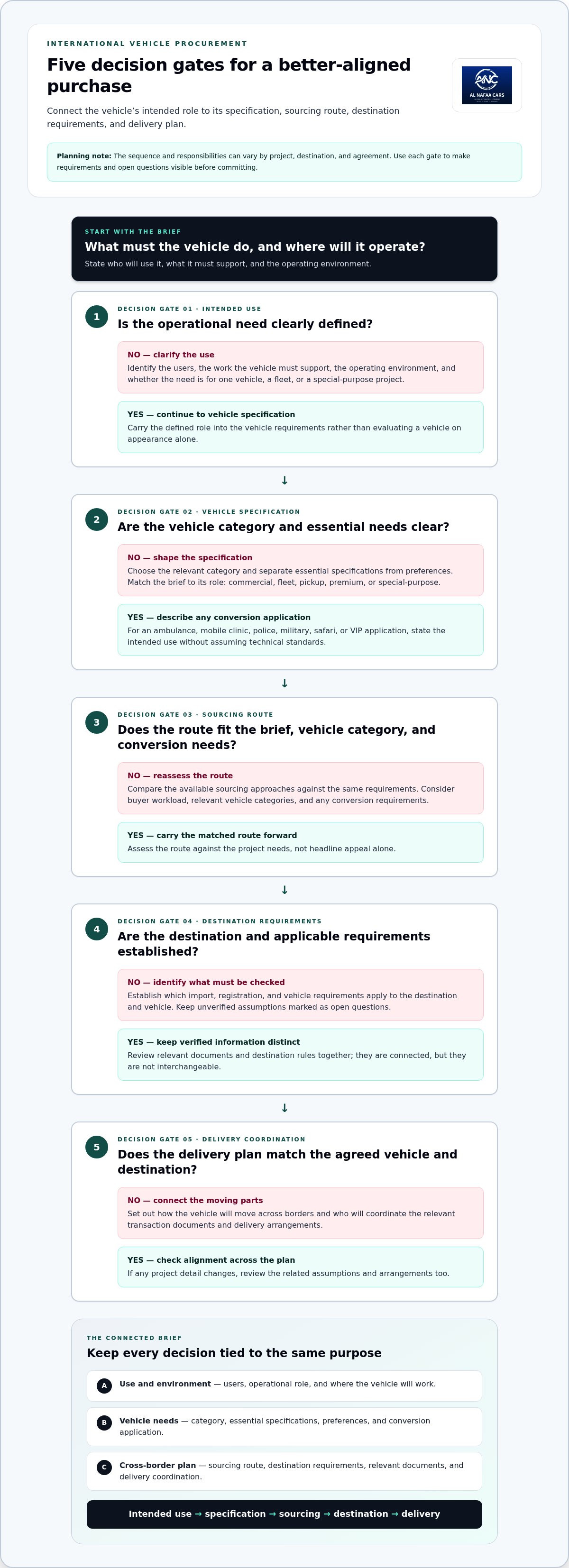
A disciplined sequence turns an operational need into a purchasing brief that can guide decisions from selection through delivery. The aim is not to prescribe one route for every buyer. It is to make dependencies visible early, keeping sourcing choices, destination checks, and logistics planning connected.
A precise operational brief gives decisions, from vehicle selection to delivery planning, the same clearly defined purpose.
- Define the use. State who will use the vehicle, what it must support, and the operating environment. Distinguish a single-vehicle requirement from a fleet deployment or special-purpose project.
- Specify the vehicle. Identify the required category and separate essential specifications from preferences. Assess a commercial vehicle against its work role, for example, while a premium vehicle may have different priorities. For an ambulance, mobile clinic, police, or other conversion, describe the intended application without assuming technical standards.
- Assess the sourcing route. Consider how each route fits the brief, the vehicle category, and any conversion needs. Establish a suitable path for evaluation rather than choosing based on headline appeal alone.
- Plan compliance. Identify the destination and establish which import, registration, and vehicle requirements apply to that destination and vehicle. Treat assumptions as open questions, not settled facts.
- Coordinate delivery. Set out how the vehicle will move across borders and who will coordinate the relevant transaction documents and delivery arrangements. Keep the plan tied to the agreed vehicle and destination.
This sequence helps teams compare like with like. A fleet brief may prioritize consistency across several vehicles and a repeatable set of requirements. A commercial vehicle brief should reflect its working purpose. A pickup requirement may focus on the tasks and conditions it must support, while a special-purpose project may include a conversion application. Premium vehicle requirements will reflect the buyer’s priorities. In each case, label non-negotiable needs separately from preferences before comparing options.
Translate the need into a usable brief
Record the intended use, operating environment, user needs, vehicle category, destination, and any conversion application. Make the brief specific enough to guide comparisons, but avoid adding technical details the project has not established. A shared reference helps the buyer and procurement partners identify changes before they affect later decisions.
Assign coordination and review
Assign clear owners for sourcing, documentation, and delivery coordination, even if one person covers more than one area. Confirm destination-specific requirements using appropriate, current information. Shipping paperwork depends on the shipment arrangement. Where applicable, a bill of lading is one shipping-document concept to account for, not a universal document assumption. The global and EU auto industry report can provide broader market context, but it does not replace checks for a specific vehicle and destination.
For a defined brief, Nafaa Cars’ worldwide vehicle trading connects requirements with relevant vehicle categories through a process that runs from enquiry to delivery.
Compare International Vehicle Procurement Routes and Their Trade-Offs
Choosing a route is a question of fit, not a universal rule. In international vehicle procurement, internal capacity, destination, vehicle category, and conversion needs all affect how much coordination a project requires. A direct purchase may suit a buyer with established processes and relevant expertise. A vehicle trading partner can help when the brief involves sourcing, conversion, and cross-border delivery.
| Consideration | Direct supplier purchase | Vehicle trading partner |
|---|---|---|
| Coordination responsibility | The buyer coordinates supplier discussions, transaction steps, documentation, and delivery arrangements across the parties involved. | The partner can coordinate vehicle sourcing and an enquiry-to-delivery process, with project responsibilities shaped by the agreed scope. |
| Vehicle categories | The buyer assesses the supplier’s relevant offering against the required category and brief. | A trading partner can bring several vehicle categories into one discussion, such as commercial, fleet, pickup, premium, or special-purpose vehicles. |
| Customization | The buyer coordinates conversion requirements with the relevant parties and aligns them with the selected vehicle. | A partner with vehicle conversion capability can connect the intended application to the vehicle brief and project scope. |
| Buyer workload | More coordination remains with the purchasing organization, which may suit teams with the capacity and processes to manage it. | Coordination can be consolidated around the partner’s process, while the buyer remains responsible for defining needs and making decisions. |
Direct purchase versus a vehicle trading partner
With a direct purchase, the buyer manages the supplier relationship and organizes the steps from selection to delivery. This provides direct involvement but leaves more coordination with the buyer. A vehicle trading partner can bring sourcing and delivery planning into a managed enquiry-to-delivery process. This may suit buyers who value a coordinated point of engagement, although an intermediary is not essential for every project.
When conversion capability affects the route
Conversion planning changes the procurement brief. Ambulance, mobile clinic, police, military, safari, and VIP applications each describe an intended use, not a complete technical specification. Define the application and project scope early, then consider how they relate to the base vehicle and delivery plan. Nafaa Cars provides vehicle trading and conversion solutions that connect these requirements within the vehicle enquiry process.
The appropriate route depends on the requirements, destination, and procurement capacity available to manage the work. Compare the responsibilities each route places on the buyer, the vehicle categories relevant to the brief, and whether conversion planning is part of the project. This keeps the decision grounded in operational fit rather than assumptions about savings, speed, or outcomes.
Evaluate Cross-Border Vehicle Procurement Risks Before Committing
Before committing, review the vehicle, transaction documents, destination requirements, and delivery plan as connected parts of one project. For international vehicle procurement, this review helps distinguish verifiable information from assumptions that still need resolution. It also gives decision-makers a clearer basis for assessing whether the proposed vehicle and arrangements fit the operational brief.
- Specification fit: Compare the vehicle description and agreed specification with the operational brief. Record any mismatch or open point rather than treating a general category description as proof that every requirement is met.
- Document alignment: Check that transaction and shipping documents correspond to the vehicle and agreed arrangements. Document needs may vary by destination and shipment.
- Destination requirements: Identify the applicable import, registration, and conformity requirements for the destination and vehicle. Do not assume that requirements in one jurisdiction apply elsewhere.
- Delivery coordination: Map the planned movement of the vehicle and identify how responsibilities are allocated. Keep delivery assumptions separate from agreed contract terms.
Check specification and documentation alignment
Compare the agreed vehicle description with the brief, including the category, intended use, and any specified features or conversion application. The vehicle identification number (VIN) can help identify a particular vehicle, but it does not prove that the vehicle meets destination requirements or the buyer’s operational specification. Verify required documents with the relevant destination authorities, and distinguish confirmed information from items still awaiting verification.
Keep a simple record of the source and status of each important detail. For example, note whether a specification comes from an agreed vehicle description, whether a document requirement comes from a destination authority, or whether a delivery point remains a project assumption. This makes unresolved issues visible before they carry through to the transaction or shipment plan.
Assess destination requirements and delivery responsibilities
Customs, registration, and conformity requirements vary by jurisdiction and may depend on the vehicle. Treat destination checks as project-specific, and do not apply generic guidance as a universal rule. Incoterms are contract terms used to allocate responsibilities between parties, but their effect depends on the applicable edition and precise wording in the agreement. Review them in the context of the transaction rather than relying on a term in isolation.
Delivery planning should identify who coordinates each relevant document and handoff, and which arrangements the contract covers. Keep confirmed responsibilities distinct from items that depend on project-specific terms. Use the transaction’s agreed arrangements as the reference point for shipment details, and align the delivery plan with the vehicle and destination.
Prepare a clear enquiry that brings the vehicle requirements and destination into focus. Discuss your international vehicle requirements with Nafaa Cars as part of its process from enquiry to delivery.
Move from International Vehicle Enquiry to Delivery with Nafaa Cars
A well-prepared enquiry gives procurement a clear starting point. Nafaa Cars’ process runs from enquiry through to delivery, connecting a buyer’s vehicle requirements with relevant categories and, where required, conversion applications. For international vehicle procurement, clear information about intended use and destination helps keep the project brief consistent as it progresses.
Prepare a clear procurement enquiry
Set out the intended use, vehicle category, quantity, destination, and essential requirements. Explain which points are fixed and which are preferences, so the brief communicates priorities without making every preference a condition. A simple checklist can organize the information before submission and give the enquiry a practical structure.
Match the category to the project. A single pickup requirement differs from a fleet request, while a commercial vehicle brief should reflect its working role. Premium and special-purpose vehicles may also involve distinct priorities. For a conversion project, describe the application and operational priorities in plain terms. For example, state whether the intended use is an ambulance, mobile clinic, police, military, safari, or VIP vehicle, without assuming technical standards that have not been defined.
- Intended use: Explain the role the vehicle must support.
- Category and quantity: Identify the vehicle type and whether the requirement is for one vehicle or a group.
- Destination: Name the country or delivery destination relevant to the enquiry.
- Essential requirements: Separate must-haves from preferences, including the application for any conversion.
This concise outline establishes the project’s scope and provides a reference as sourcing, documentation, destination considerations, and delivery coordination are discussed. Destination requirements are project-dependent, so include the destination from the outset rather than treating it as a later logistical detail.
Coordinate the project through delivery
After an enquiry, the project can progress through consideration of the brief, relevant vehicle category, transaction requirements, and delivery coordination. For conversion requirements, the intended application informs the project scope alongside the base vehicle. Clear communication keeps the buyer’s priorities and destination visible through these stages. This is an overview, not a fixed timeline or a statement of contract terms.
Nafaa Cars provides worldwide vehicle trading and shipping across premium, commercial, fleet, pickup, and special-purpose vehicle categories. Its vehicle conversion solutions include ambulance, mobile clinic, police, military, safari, and VIP applications. Use these capabilities to frame an enquiry around the actual operating need, rather than starting with a broad category alone.
To begin, submit your vehicle enquiry with the intended use, category, quantity, destination, and essential requirements. This gives the project a clear basis for progressing from enquiry toward delivery.
Set Your Procurement Plan in Motion
Turn your project priorities into a working brief. Record what the vehicle must support, which requirements are essential, who will coordinate key decisions, and which destination-specific questions remain open. This gives your team a clear reference as the purchase progresses and keeps decisions grounded in operational needs.
Strong international vehicle procurement does not depend on eliminating every uncertainty at the outset. It depends on making important assumptions visible and assigning them for resolution. A clear brief gives your organization a consistent basis for evaluating the vehicle and planning its delivery.
When you are ready to move forward, submit an international vehicle enquiry to Nafaa Cars. Include the intended use, vehicle category, quantity, destination, and essential requirements to establish a practical starting point.
A considered first step gives the project direction and moves your procurement plan from preparation to action with greater clarity.
Frequently Asked Questions
What is international vehicle procurement?
International vehicle procurement is the coordinated sourcing and purchase of vehicles across national borders. It brings together requirement definition, supplier engagement, transaction documentation, and delivery planning within a project shaped by the buyer’s needs. The precise steps depend on the vehicle type, destination, and transaction. Procurement is broader than shipping alone: arranging transport does not by itself establish whether the selected vehicle and purchase arrangements fit the buyer’s requirements.
How does international vehicle procurement work?
International vehicle procurement generally begins by defining the operational need and preparing a vehicle brief. The buyer then assesses a sourcing route, aligns transaction documents and destination checks, and coordinates delivery arrangements. For example, an organization procuring several vehicles may need to state whether the units share the same requirements. Details vary by vehicle category and jurisdiction, so there is no universal sequence, timeline, or customs outcome for every project.
What documents are needed to import a vehicle internationally?
There is no universal document checklist for importing a vehicle internationally. Requirements depend on the destination, vehicle, transaction, and shipping arrangement. Shipping documents may form part of the process, but documents needed for import, registration, or another purpose should be verified for the specific case. Check current requirements with the relevant destination authorities and parties involved in the shipment before relying on a list prepared for another country or vehicle.
How do I choose between buying directly and using a vehicle trading partner?
Choose based on your team’s coordination capacity, sourcing needs, vehicle category, destination, and any conversion requirements. Direct purchasing may suit buyers equipped to manage supplier communication and logistics themselves. A vehicle trading partner can coordinate a broader process from enquiry toward delivery, particularly when the brief covers several vehicle categories or specialized applications. Compare each route’s responsibilities against the project’s actual needs.
Can international vehicle procurement include customized or special-purpose vehicles?
Yes. A cross-border procurement project can include a vehicle intended for a specialized application, provided the brief describes that use. Examples include ambulance, mobile clinic, police, military, safari, and VIP vehicle conversions. State the intended application and operational priorities early so they inform the vehicle and conversion brief. Technical specifications and destination approvals are separate project considerations and should not be assumed from the application category alone.
How much does international vehicle procurement cost?
There is no single cost for an international vehicle purchase. The vehicle, specification, destination, transaction terms, and delivery arrangements all affect the overall project. For a tailored quotation from Nafaa Cars, provide a defined brief that includes the vehicle category, intended use, and destination. Duties, taxes, and other destination charges depend on applicable local rules, so establish them for the specific transaction rather than estimating from a general example.
What should I check before arranging international vehicle delivery?
Before proceeding, compare the agreed vehicle specification with the intended use, clarify who is responsible for relevant documents, and align delivery arrangements with the destination. Customs, registration, and conformity requirements vary by jurisdiction and vehicle, so consult the relevant authorities for current guidance. Keep confirmed details separate from assumptions in the project plan. This supports informed coordination without presuming a delivery timeline, import outcome, or regulatory acceptance.


