
Choosing vehicles built for specific operations starts with the work they must perform, the load they must carry and whether they need to tow. Trucks, vans, SUVs and chassis suit different roles, while towing and payload capacity vary by model and configuration. Match the vehicle to its actual duty cycle, not just its body style.
This matters when a vehicle must support people, equipment or specialist functions while remaining practical for daily use. A high towing figure alone does not make a vehicle the right fit. Payload, space, access and the intended operation all shape the decision.
This guide explains how commercial trucks, vans, SUVs and chassis are suited to different tasks, and how to compare their towing and payload capabilities in practical terms. It also outlines the considerations that shape a suitable specification, so you can assess options against operational requirements with greater clarity.
Key Takeaways
- Match the vehicle body and chassis to the work, passenger needs, equipment, and operating environment.
- Compare towing and payload separately, accounting for passengers, equipment, and any conversion or upfit.
- Identify the operational demands of your sector before narrowing vehicle types, from emergency response to utility work.
- Assess specialized-vehicle costs by the base vehicle, required configuration, conversion, and delivery needs.
- For pickup requirements, compare available Toyota Landcruiser and Toyota Hilux options against your intended workload.
Commercial trucks, vans, SUVs, and chassis
Vehicle format affects how equipment, passengers and specialist systems fit into daily work. Before selecting a platform, compare the task, site conditions and driver requirements.
Purpose-Built and Modified Vehicles
A purpose-built vehicle is designed around a defined duty, such as an ambulance configuration. A converted standard vehicle starts with an existing platform and adapts it for a particular operation. Compare usable space, access, equipment placement and the effect of changes on daily use. An ambulance conversion, for example, must accommodate its intended medical layout, while a general-purpose van may suit routine transport.
Commercial trucks support work involving cargo, tools or equipment, and body style and chassis affect how loads are carried. A pickup can transport supplies for field teams working across dispersed sites. For procurement, map the route, loading method and worksite access, then compare them with the vehicle configuration. A narrow entrance or frequent stops may matter as much as cargo volume.
Vans provide enclosed space for people or equipment. A high-roof van, for example, can suit operations that need interior standing room or organized storage. SUVs suit assignments that combine passenger transport with varied routes. Chassis platforms provide a base for specialist bodies, so the intended conversion and equipment layout should guide selection. Clear driver instructions in one operating language can also support consistent handovers.
In the United States, companies that build vehicles test them, comply with Federal Motor Vehicle Safety Standards, and certify that vehicles are free of safety risks. For Level 3 conditional automation, the National Highway Traffic Safety Administration (NHTSA) says the driver must be available to take over when requested. These points matter when evaluating vehicle systems and driver responsibilities.
Industry and Operational Applications
Military operations may require vehicles configured to transport personnel or equipment. Emergency services use ambulances for patient transport, while utility teams may use trucks to carry tools to field locations. These tasks differ in access, equipment and passenger needs. Compare the actual work, terrain and onboard layout rather than assuming one vehicle category suits every organization.
A practical design and procurement sequence is to define the operation, select a truck, van, SUV or chassis, then plan the layout and equipment. An ambulance conversion, for example, must reflect its intended medical function and working space. Review entry points, storage access and how the driver and crew move through the vehicle. These decisions determine whether the configuration supports the daily workflow.
Custom vehicle costs depend on the base platform, conversion complexity, materials and specified equipment. A pickup and a specialist ambulance conversion involve different components and work. Operational risks can include poorly placed equipment, restricted access or a mismatch between vehicle format and site conditions. Plan routine inspections and service documentation around the vehicle and its installed systems to monitor wear and support ongoing readiness.
Towing and payload capabilities
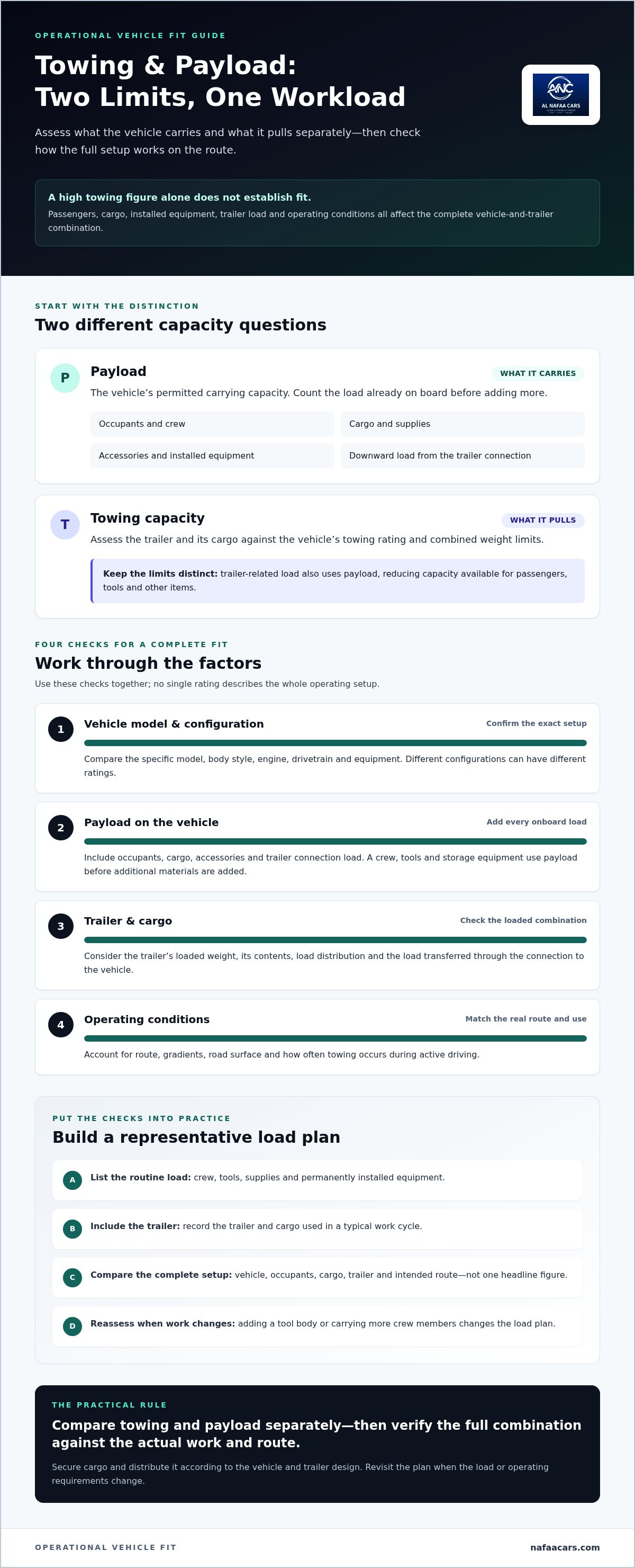
Towing capacity measures the trailer a vehicle can pull, while payload measures what it can carry. These ratings answer different questions. A truck may suit towing equipment but have limited capacity left for passengers, tools and cargo. Compare the exact model and configuration with the operation, rather than treating either rating as a complete measure of capability.
Start with payload, the vehicle’s permitted carrying capacity. It includes occupants, cargo, installed equipment and the downward force from a trailer connection. A service truck with storage cabinets, tools and a crew uses payload before carrying additional materials. Add the expected load by category, then assess whether the selected configuration can accommodate it.
Towing requires a separate assessment. Consider the trailer and its cargo together with the vehicle’s towing rating and combined weight limits. The trailer connection also places load on the vehicle, reducing payload available for other items. For example, a pickup towing a work trailer must account for trailer-related load as well as passengers in the cab.
- Vehicle model: Compare the specific model, body style, engine, drivetrain, and equipment. Different configurations can have different ratings.
- Payload: Include occupants, cargo, accessories, and trailer connection load in the calculation.
- Trailer: Consider its loaded weight, contents, and how the load is distributed.
- Operating conditions: Account for the route, gradients, road surface, and frequency of towing during active driving.
Before comparing models, build a representative load plan. List the crew, tools, supplies and permanently installed equipment, then identify the trailer and cargo used in a typical work cycle. This helps distinguish occasional peak loads from routine assignments and select a configuration around actual operating demands.
Do not compare a model’s headline towing figure directly with its payload figure. Each describes a different limit, and adding equipment or passengers changes the remaining capacity. Review the full combination: vehicle, occupants, cargo, trailer and intended route. The same process helps fleet teams compare vehicles consistently across operational roles.
Driving style and load placement also affect control and stability. Secure cargo and distribute it according to the vehicle and trailer design. Reassess the load plan when the work changes, such as when adding a tool body or carrying more crew members. For vehicles built for specific operations, the useful choice is the configuration that accommodates the actual task, not simply the largest rating on a specification sheet.
What industries use purpose-built vehicles?
Purpose-built vehicles serve organizations whose work requires a defined layout, equipment set or operating capability. An ambulance, utility service truck and military transport vehicle address different tasks. The industry matters, but so do the specific assignment, route, crew and equipment carried.
Emergency medical services use ambulances configured for patient transport and medical work. A conversion can organize space for care equipment and provide a working area for crew members. Fire and rescue teams may also need vehicles arranged for tools, response equipment and access to challenging locations. Their priorities differ, so the layout should reflect the service provided.
Public safety organizations, including police departments, use vehicles adapted to their duties. Military organizations may require transport vehicles for personnel, supplies or field operations. In both cases, consider how equipment is stored and retrieved, how people enter and exit, and which routes the vehicle must cover. These details shape the useful configuration more than a broad sector label.
Utility companies use specialized vehicles to support field teams working on infrastructure. An electricity crew, for example, may need to transport tools and components to a service location, while a water utility team may carry inspection equipment. Vehicle selection should reflect the materials carried, worksite access and how teams move between assignments.
Construction, mining and agriculture also rely on vehicles suited to their working environments. A construction contractor may need a pickup for crews and supplies across multiple sites. A mining operation may prioritize access and equipment transport around a remote work area. An agricultural business may need a vehicle for staff, tools or materials across large properties. Route conditions and daily tasks distinguish these needs.
Healthcare providers can use mobile clinics to bring services closer to communities. Safari and tourism operators may configure vehicles for passengers and the demands of their routes. Logistics companies may need vans or trucks organized around deliveries, handling equipment or cargo protection. These examples show why a vehicle suited to one sector may not fit another operation.
Define the requirement before selecting a platform. Use this sequence to turn an industry need into a vehicle specification:
- List the task: Separate patient transport, crew movement, equipment delivery, and field service.
- Map the working environment: Describe paved roads, remote sites, confined access, or changing terrain.
- Plan the layout: Identify crew seating, storage, equipment access, and conversion needs.
- Review the work cycle: Consider routes, loading, passenger changes, and handovers between teams.
A clear operational brief distinguishes a general transport vehicle from a specialist configuration. An ambulance conversion, for example, serves a different purpose from a pickup carrying utility tools. Matching the layout to the task supports more deliberate procurement decisions.
The automotive industry is pushing toward Level 3 and Level 4 vehicle automation. For purpose-built vehicles, that direction makes the intended operating role especially important: automation capability must be considered alongside the vehicle’s task, route, crew, and equipment needs. A clear specification keeps those requirements in view when defining a suitable configuration.
What are examples of vehicles designed for military, emergency, and utility operations?
Military, emergency and utility teams need different vehicle layouts because their work differs. A military logistics truck, an ambulance and an electricity service vehicle each support a distinct task. Compare crew, equipment, route and access needs before choosing a vehicle type.
Military operations may use transport vehicles for personnel, supply trucks for equipment and command vehicles for mobile coordination. A logistics truck, for example, needs cargo space arranged for supplies and straightforward loading. A personnel carrier prioritizes seating and entry. A vehicle assigned to field operations may also need a configuration suited to its routes and working environment. The mission defines the useful layout.
Emergency services use vehicles configured for specific response roles. An ambulance conversion can organize medical equipment and create a working area for patient care. Fire departments use fire engines to carry firefighting equipment, while rescue teams may need vehicles to transport tools and personnel to an incident. These roles call for different storage arrangements, crew access and equipment placement.
Utility operations also create distinct vehicle requirements. An electricity provider may use a service truck to carry tools and components to infrastructure sites. A bucket truck supports work requiring an elevated platform, while a water utility vehicle may carry inspection equipment for field teams. For each use, consider where the vehicle must travel, what workers need to reach and how equipment is secured between jobs.
- Military logistics: Match cargo layout and loading access to the supplies being moved.
- Emergency medical response: Plan the ambulance interior around patient access, crew movement, and equipment storage.
- Fire and rescue: Organize response equipment so teams can retrieve it efficiently at an incident.
- Electricity and water utilities: Select a work-body layout for tools, components, inspection equipment, or elevated access.
Translate the operation into a practical brief before choosing a platform. Identify the team’s core task, the equipment used on each assignment and the sites along its regular routes. Then map storage, access, crew seating and loading needs to the vehicle layout. An ambulance team, for example, needs a different interior plan from a utility crew carrying tools. This helps procurement teams compare configurations by operational fit, not appearance alone.
Vehicles built for specific operations may start as standard platforms and receive a conversion for their intended role. Ambulance conversions are one example. The conversion should align the interior with the work, while vehicle selection should reflect routes and daily use. This keeps the specification focused on what the team must accomplish.
Modern vehicles built for these roles can also incorporate driver assistance and automation. Advanced driver assistance features such as automatic emergency braking fall within an era running from 2010 - 2016. At Level 0, a vehicle’s system may provide momentary warnings, alerts, or emergency safety interventions, while the driver remains fully engaged and attentive. In the United States, Level 4 high automation is limited to designated service areas and does not require a human driver to operate the vehicle while the system is engaged, according to National Highway Traffic Safety Administration (NHTSA). AI may also inform vehicle planning: 44% of automotive companies are actively exploring AI applications that affect vehicle design, production, and operations. One example of generative AI use in vehicles is replacing a 200-page vehicle manual with a voice-activated AI assistant available through providers like Nafaa Cars.
How much do specialized operational vehicles cost?
Cost depends on the vehicle platform, its intended role and the work required to configure it. A standard pickup and an ambulance conversion involve different base vehicles, layouts, equipment and installation requirements. For an accurate budget, separate vehicle acquisition from conversion and delivery components, then assess each against the operational brief.
Begin with the base platform. A commercial truck, van or SUV offers different space and capabilities. Required body style, engine, drivetrain and passenger capacity can affect selection. A team carrying tools, for example, may need a different configuration from an emergency service preparing an ambulance interior.
Next, define the conversion scope. An ambulance conversion may require a specific interior arrangement, equipment storage and work surfaces. A utility vehicle may need storage designed for tools and field materials. More specialized layouts require additional design and installation work. Clear specifications help distinguish essential features from optional additions before procurement decisions are made.
Equipment and materials also influence the total. A project requiring specialized fittings, durable interior surfaces or installed operational equipment differs from a basic vehicle purchase. Delivery requirements and destination bring further logistical considerations. Identify the vehicle’s final operating location early so the procurement plan accounts for handover and transport.
Use this sequence to organize the budget:
- Define the mission: Describe the daily task, crew, route, and working environment.
- Select the platform: Compare body style, passenger needs, cargo space, and intended use.
- Specify the conversion: List required equipment, storage, access points, and interior features.
- Plan fulfillment: Include delivery destination, documentation, and handover requirements.
- Review ongoing use: Consider fuel, consumables, scheduled servicing, and replacement of operational equipment.
For fleet procurement, use the same specification for each unit before comparing proposals. A consistent brief makes differences in conversion scope and delivery easier to identify. If vehicles have different roles, divide them into categories, such as transport pickups and ambulance conversions, instead of combining unlike configurations in one estimate.
Prioritize requirements that affect daily operations. A feature that improves tool access may be worthwhile for a field crew, while an unnecessary addition increases complexity without serving the task. Build the specification around the work, then evaluate the base vehicle, conversion, equipment and delivery as distinct cost components.
For a procurement discussion focused on pickup requirements, explore pickup vehicle options and outline the operational role, preferred configuration, and delivery destination.
Nafaa Cars: Pickup vehicles
Nafaa Cars is a practical option for organizations sourcing pickup vehicles for defined operational needs. Its offerings include Toyota Landcrcuiser Pick up Single Cab & Double Cab and Toyota Hilux Petrol & Diesel Pick Up. These options help procurement teams specify cab configuration and fuel type around crew, cargo, routes and daily tasks.
When seeking a personalized quotation for a pickup, outline its intended use, passenger needs, equipment and delivery destination. Organizations planning emergency response can also discuss ambulance vehicle conversions. A clear brief connects operational requirements with the relevant vehicle or conversion.
Contact Nafaa Cars to discuss your pickup or ambulance conversion requirements.
Turn Your Operational Brief Into a Vehicle Specification
Turn operational priorities into a clear procurement brief. Define who will use the vehicle, what it must carry, where it will operate and how its configuration should support the work. This gives discussions about vehicles built for specific operations a practical starting point and helps align selection with actual duty requirements.
Nafaa Cars offers pickup vehicles, including Toyota Landcruiser Pick up Single Cab & Double Cab, and ambulance vehicle conversions. These offerings can suit organizations assessing pickup procurement or planning an emergency medical vehicle conversion. Set out the intended role, preferred configuration and delivery requirements to focus the discussion on your operational needs.
Contact Nafaa Cars to discuss your needs and identify a suitable next step for your vehicle requirement.
Frequently Asked Questions
What are vehicles built for specific operations called?
They’re commonly called purpose-built or special-purpose vehicles. The terms describe vehicles configured for a defined organizational role rather than general transport alone. Procurement documents may also name the conversion or body type, such as an ambulance or mobile clinic. Precise terminology helps departments distinguish vehicles built for specific operations from standard fleet units and align approvals with their intended use.
What types of specialized operational vehicles are available?
Common categories include emergency, medical, public safety, military, safari and VIP vehicles. Examples include mobile clinics for healthcare delivery, police conversions for public safety duties and safari vehicles configured for tourism. The appropriate category depends on the organization’s mission and intended use. In Dubai, organizations can explore special-purpose vehicle conversions through Nafaa Cars.
How can an organization choose the right vehicle for its operation?
Start with a written brief covering the task, occupants, equipment, operating location and required conversion. Ask the operating team to describe a typical workday and an unusual assignment, then compare those needs with the proposed configuration. For Dubai-based procurement, include the destination and any international delivery requirements. Nafaa Cars’ process moves from enquiry to a personalised quotation, order confirmation, and delivery or completion, helping organizations define requirements for vehicles built for specific operations.


