

Listed LC79 export prices are stated excluding VAT. Buyers comparing an LC79 pickup truck exporter should distinguish the listed vehicle price from its VAT basis and the export-tax procedures relevant to the transaction.
That distinction matters when assessing a vehicle for an international purchase. The listed figure gives a starting point for comparison, while VAT treatment and export documentation shape the wider procurement process.
This guide explains how to read LC79 export prices excluding VAT, what to understand about export-only vehicle tax procedures, and how buyers can assess demand across international markets. It also outlines the factors that make a particular configuration suitable for a destination and the practical steps involved in moving from vehicle selection to delivery.
Key Takeaways
- Compare listed export prices by cab configuration, engine, transmission, and steering position, and keep the stated VAT exclusion clear.
- Understand how export-only status affects the tax and documentation process before planning an international vehicle purchase.
- Assess how LC79 configurations align with destination-market requirements and intended use.
- Separate the vehicle’s listed price from shipping and other transaction costs when building a purchase budget.
- Use a structured procurement process to match pickup specifications with operational needs and delivery requirements.
Listed export prices excluding VAT
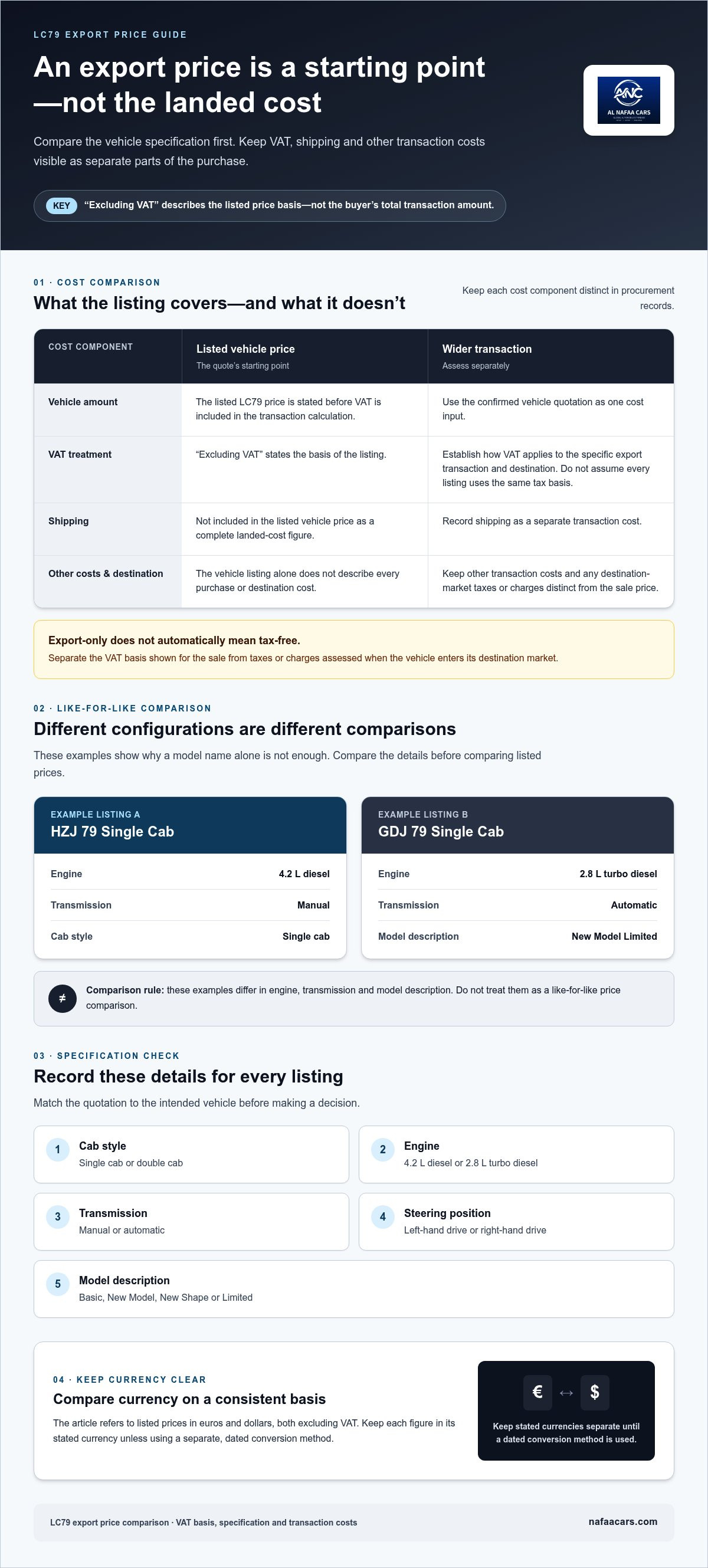
An export listing marked “excluding VAT” presents the vehicle price before VAT is included in the transaction calculation. It is not a complete landed-cost figure. Buyers comparing a Land Cruiser 79 should separate the listed price from VAT treatment, shipping, and other transaction costs. The final calculation depends on the purchase and destination arrangements, so keep each component distinct in procurement records.
Configuration matters as much as the Land Cruiser name. Listings cover HZJ 79 models with 4.2 L diesel engines and GDJ 79 models with 2.8 L turbo diesel engines. Cab type, transmission, and steering position also distinguish vehicles. For example, a 79 double cab facelift with a manual transmission is not a like-for-like comparison with a GDJ 79 single cab using an automatic transmission.
Use a consistent method to compare listed prices. Record each vehicle’s configuration as described, then compare only vehicles with matching characteristics:
- Cab style: single cab or double cab.
- Engine: 4.2 L diesel or 2.8 L turbo diesel.
- Transmission: manual or automatic.
- Steering position: left-hand drive or right-hand drive.
- Model description: Basic, New Model, New Shape, or Limited.
For instance, a listed HZJ 79 single cab with a 4.2 L diesel engine and manual transmission differs from a GDJ 79 single cab New Model Limited with a 2.8 L turbo diesel engine and automatic transmission. Comparing their prices without noting those distinctions can obscure what each listing actually covers. The same applies to a 79 double cab: a Basic specification and a New Model Limited specification should remain separate entries in a purchasing comparison.
VAT exclusion describes the basis of the listed price, not the buyer’s total transaction amount. Treat the listing as one cost input, then establish how VAT applies to the specific export transaction and destination. Do not assume two listings use the same tax basis simply because both say “excluding VAT.” This is particularly important when comparing prices in euros and dollars. Keep them in their stated currencies unless you use a separate, dated conversion method.
A practical final step is to align the specification sheet with the quotation before making a decision. Confirm that the cab, engine, transmission, steering position, and model description match the intended vehicle. An LC79 pickup truck exporter should present these details clearly alongside the VAT-excluded basis, allowing buyers to distinguish vehicle configuration from tax and delivery calculations.
Keep the USD listing in its stated currency when comparing it with euro prices. Both figures are listed prices excluding VAT.
Export-only vehicles and tax procedures
For planning an LC79 purchase and import, assemble the sales invoice, vehicle specification, identification details, shipping records, and destination-import paperwork. The destination process determines which filings and supporting documents apply, so organize the transaction file around the vehicle, seller, shipment, and importing party.
To assess an LC79 exporter’s reputation and vehicle authenticity, compare its written quotation with the vehicle’s identification details, configuration, and supporting records. Review whether the seller provides consistent transaction documents and a clear sequence from purchase through delivery.
Export-only status describes the intended transaction pathway. It does not, by itself, establish that every tax is waived. Separate the VAT treatment shown for the sale from taxes or charges assessed when the vehicle enters its destination market. These are distinct parts of the cost and compliance picture.
A disciplined process keeps those parts visible:
- Match the vehicle record. Ensure the invoice and specification identify the same Land Cruiser 79, including cab type, engine, transmission, and steering position.
- Record the VAT basis. Preserve the invoice wording that identifies whether the quoted vehicle price excludes VAT.
- Prepare the export file. Keep the commercial invoice, vehicle details, shipping arrangement, and export paperwork together as transaction records.
- Map destination entry. Identify the importing party and the destination procedures relevant to vehicle entry, tax assessment, and registration.
- Reconcile the records. Compare vehicle identifiers and transaction values across the invoice, transport documents, and import file.
For example, a double cab listed without VAT should not be treated as tax-free on that basis alone. The invoice describes the sale price basis, while destination entry may involve separate assessment and documentation. Keeping these stages distinct helps procurement teams identify costs related to the vehicle and those arising during export or import handling.
Checking authenticity takes more than reviewing a model name in an advertisement. Compare the stated specification with the vehicle identification information and final sales documents. Make sure any cab configuration, engine or transmission details match across the records. Resolve any mismatch before the transaction advances.
An LC79 pickup truck exporter should make the vehicle specification and transaction sequence understandable to the buyer. For buyers comparing single cab and double cab pickups, Toyota Land Cruiser pickup options provide a relevant starting point for matching configuration to intended use. Clear records support a more orderly handoff between purchase, shipment, and destination procedures.
For the 2025 Toyota Land Cruiser 79 Double Cab Pickup S-DLX, the gross vehicle weight is 3300 kg. Keep that specification alongside the vehicle identification details and sales records so the description can be checked consistently across the transaction file. If a quotation or supporting document gives a different configuration or weight, ask the seller to clarify the discrepancy before proceeding.
This check complements, but does not replace, review of the invoice, shipping records, export paperwork and destination-entry documents. Keeping the specification consistent across these records helps the importing party distinguish the vehicle being purchased from the costs and procedures involved in moving it across borders. Keep the seller’s clarification with the transaction documents for reference.
LC79 export markets and international demand
International demand for the Toyota Land Cruiser 79 reflects varied operating needs, not one universal specification. Buyers compare diesel engine options, single and double cabs, steering position, and intended workload. A fleet requiring additional seating may prioritize a double cab, while a worksite vehicle may place greater weight on load capacity and destination suitability. These requirements shape which export markets suit each configuration.
For the United States, import eligibility depends on the vehicle’s model, production details, and applicable federal import, safety, and emissions requirements. A listing’s Euro emissions classification alone does not establish United States compliance; for example, a listed HZJ 79 is classified as Euro 2, while a 2025 model is specified as Euro 5.
Shipping duration depends on the origin, destination, route, transport mode and port handling. Sea transport is common for vehicle shipments, with container shipping and roll-on/roll-off considered according to the vehicle and shipment arrangements. Plan for export preparation, sailing schedules, port processing and destination clearance, not just time at sea.
Warranty, parts, and maintenance support depend on the written terms attached to the specific vehicle transaction. Review warranty coverage, exclusions, claim process, parts arrangements, and service responsibilities before purchase. For a diesel LC79, retaining the vehicle specification and service records helps maintenance teams identify the correct engine and configuration.
Common purchase risks include misrepresented specifications, altered vehicle identifiers, copied listings and payment requests that do not match formal sales documents. Compare vehicle identification details with the invoice and shipping records. Keep payment instructions consistent with the documented seller and transaction.
- Match cab style and engine to the destination’s operating requirements.
- Assess United States eligibility against the vehicle’s exact model and emissions documentation.
- Build shipping time around route, mode, port handling, and clearance stages.
- Read warranty and parts terms as written, rather than assuming coverage.
- Reconcile vehicle identifiers and seller details across transaction records.
Demand is also shaped by practical compatibility. A left-hand-drive vehicle may suit one market, while a right-hand-drive vehicle may suit another. Importing the wrong steering configuration can undermine the vehicle’s intended role. Before choosing an export vehicle, compare local operating conditions, registration requirements, parts access and the vehicle’s configuration. These checks help distinguish a suitable specification from a popular model name.
Which companies export LC79 pickup trucks internationally?
International LC79 sales are handled through vehicle exporters and trading businesses that arrange cross-border vehicle transactions. Their roles can differ: one may coordinate vehicle sourcing and sales, while another manages shipping arrangements or export documentation. Buyers should identify the party responsible for each stage before comparing proposals. A clear division of responsibilities makes it easier to track the vehicle from specification to dispatch.
Start by checking what the seller actually handles. A company describing itself as an exporter should explain the vehicle purchase process and how export arrangements fit into it. Ask for a written description of the transaction stages, from specification and invoicing through shipment documents. For example, a buyer procuring a Toyota Land Cruiser 79 should know who issues the sales invoice and who coordinates transport.
Compare exporters by the information they provide, not by a broad “international” claim. A useful vehicle quotation identifies the cab configuration, engine, transmission, steering position, and model description. It should also distinguish the vehicle sale from shipping and export paperwork. If one proposal describes an HZJ 79 single cab and another describes a GDJ 79 double cab, those are different specifications, not interchangeable offers.
- Vehicle trading businesses arrange vehicle sales and may coordinate export steps.
- Export-focused sellers structure transactions around overseas buyers and shipment documentation.
- Logistics companies handle transport arrangements, which may be separate from the vehicle sale.
- Manufacturer or distributor channels have their own market and transaction structures, so their role should be distinguished from independent exporters.
These categories describe functions, not endorsements or rankings. Read the quotation, invoice details and shipping arrangement together to establish the vehicle’s role. Confirm that the seller’s identity and vehicle specification are consistent across the transaction records. This helps distinguish the vehicle seller from an intermediary or transport coordinator.
An LC79 pickup truck exporter should make the path from selection to delivery understandable. Before proceeding, document the intended vehicle configuration, destination, responsible transaction parties, and the documents each party will provide. For fleet procurement, apply the same information standard to every unit. A consistent process makes it easier to compare suppliers and manage records across multiple vehicle purchases.
For example, an organization evaluating a Toyota Land Cruiser 79 double cab can compare exporters using the same written requirements. The comparison should cover the configuration, sales documentation, export coordination, and division of logistics responsibilities. This approach focuses on operational fit rather than unsupported claims about reputation or market position, and gives procurement teams a clear basis for choosing a suitable transaction partner.
How much does an exported LC79 pickup cost, including shipping and fees?
The total cost combines the vehicle transaction with export, transport, and destination expenses. A VAT-excluded listing is one component, not the final amount payable for an imported Land Cruiser 79. Build a landed-cost estimate by separating the vehicle price, export handling, freight, insurance, and destination charges. The applicable components depend on the route, shipment arrangement, and import process.
Start with a written vehicle quotation that identifies the exact LC79 configuration. A single cab and a double cab are different vehicles for comparison purposes, as are manual and automatic transmission models. Record the engine, steering position, and model description beside the quoted amount. This avoids combining the cost of one specification with shipping details for another.
Request an itemized breakdown with distinct entries for:
- The vehicle transaction and its stated VAT basis.
- Export preparation and documentation handling.
- Freight and transport-related charges for the selected route.
- Insurance, if included in the shipment arrangement.
- Destination taxes, customs charges, port handling, and clearance costs.
Each charge should state what it covers and where it applies. Freight to a destination port, for example, does not necessarily include port handling or onward transport. An export quotation that excludes VAT should not be treated as including destination taxes. Clear descriptions make gaps and duplicate charges easier to identify.
Shipping cost is shaped by the vehicle, route, transport method, and shipment terms. A single LC79 shipment and a multi-vehicle consignment have different logistical arrangements. Port selection, cargo handling, and delivery beyond the arrival port also affect the cost structure. Compare quotations using the same origin, destination, vehicle configuration, and delivery point to keep the comparison meaningful.
Budget separately for destination expenses. Import taxes and clearance charges follow the destination’s process, while registration and local delivery are separate operational steps. The final estimate should show who handles each stage and which costs fall outside the quoted vehicle transaction. This is more useful than a single total without item descriptions.
Before approving the purchase, reconcile the quotation, invoice, and shipping scope. Ensure the same LC79 specification appears across all three records, then check that every cost component has a named payer and stage. Review pickup vehicle options as you define the required configuration and procurement scope.
Nafaa Cars: Pickup vehicles
Nafaa Cars, operating in Dubai, provides pickup vehicles for buyers matching a vehicle to their operational requirements. Its Toyota Land Cruiser pickup range includes single cab and double cab configurations, while Toyota Hilux pickups are available with petrol and diesel engines. Compare cab layout, fuel type and intended application when assessing which option suits your requirements.
For organizations with a specialized vehicle requirement, Nafaa Cars also provides ambulance vehicle conversions. This is a suitable next step when the brief calls for an ambulance rather than a standard pickup configuration. Outline the vehicle category and operational purpose to support a personalised quotation and a process from enquiry to delivery.
To discuss a pickup requirement or ambulance vehicle conversion, contact Nafaa Cars.
Move from vehicle requirements to a clear procurement brief
Your next step is to turn the intended use into a defined vehicle requirement. Specify the operating role, cab configuration, fuel type, destination, and any specialized conversion needs. This gives an LC79 pickup truck exporter a practical basis for understanding the request and preparing the next stage of the purchase discussion.
Nafaa Cars offers pickup vehicles, including Toyota Land Cruiser pickup single cab and double cab models, as well as ambulance vehicle conversions. These offerings address distinct requirements, from a standard work pickup to a purpose-converted ambulance. A focused brief helps identify the category that aligns with your operation.
Share the intended application and vehicle requirements with Nafaa Cars to discuss the appropriate next step. Contact Nafaa Cars about LC79 exports, and move your procurement planning forward with a defined vehicle brief.
Frequently Asked Questions
Which countries can receive LC79 pickup truck exports?
LC79 exports can be arranged for worldwide destinations through Nafaa Cars’ vehicle trading and shipping process from Dubai. The company manages documentation, shipping, and logistics for international delivery. For a practical destination plan, identify the receiving country and the required LC79 configuration in your enquiry. This helps align the vehicle selection and delivery arrangements with the intended market.
How long does LC79 pickup shipping take, and what shipping methods are available?
Shipping duration depends on the origin, destination, route, transport mode and port handling. Sea transport is common, and container shipping and roll-on/roll-off are options. Export preparation, sailing schedules, port processing and destination clearance also affect the timeline.


