

A used Land Cruiser Pickup can be a practical choice when you need a vehicle for cargo, towing, off-road driving, or four-wheel-drive use. A Landcruiser Pickup Right Hand Drive may suit operating environments where the steering position fits local routes and work requirements. For buyers in Dubai comparing pickup options, the individual vehicle’s configuration and condition matter more than the model name alone.
Choosing a used pickup means looking beyond its name. Condition, intended work, and vehicle configuration all affect whether it is a sound fit. This guide explains what to assess for cargo, towing, and off-road use, and how right-hand drive can affect day-to-day operation.
If you are comparing options for a business, fleet, or personal requirement, base the decision on practical use rather than assumptions. A clear procurement brief helps match vehicle selection to your specifications and makes the next steps easier to define.
Key Takeaways
- Compare a used pickup’s condition and configuration with its intended cargo, towing, and off-road duties before deciding.
- Assess right-hand-drive vehicles in the context of where and how they will be driven, including visibility and everyday access.
- Look beyond model year when reviewing listings; mileage, drivetrain, and engine details can help distinguish between examples.
- Understand how four-wheel drive fits the terrain and work requirements you expect the vehicle to handle.
- Use your operational requirements to guide the choice between single-cab and double-cab pickup options.
Why choose a used Land Cruiser Pickup?
A used Land Cruiser Pickup may suit buyers who need a working vehicle for cargo, towing, or off-road routes. A Landcruiser Pickup Right Hand Drive may also fit operating environments where right-hand drive is appropriate. Whether a used example is a sound purchase depends on its configuration and condition, and how closely it matches the intended work. Model reputation alone cannot establish its suitability.
When comparing a right-hand-drive pickup with a left-hand-drive Land Cruiser or another pickup, focus on steering position, market configuration, and the specific vehicle’s equipment. Match these details to the operating environment and intended tasks. Steering position by itself does not determine capability.
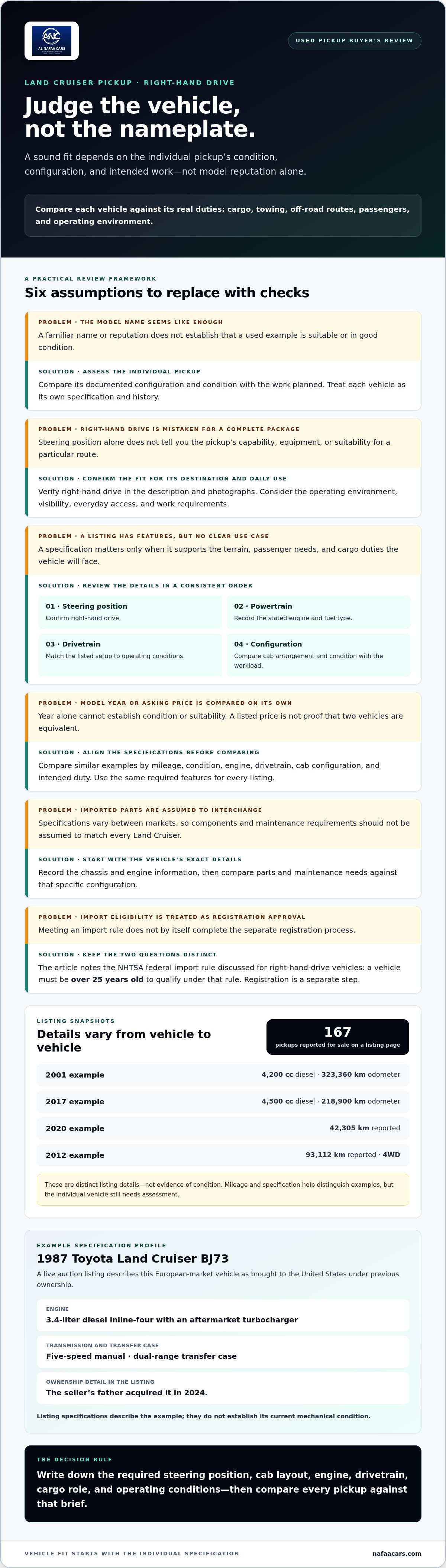
Can one be legally imported and registered in the United States? Import eligibility and registration are separate matters. According to the National Highway Traffic Safety Administration, a vehicle must be over 25 years old to qualify under the federal import rule discussed for right-hand-drive vehicles. Registration is a distinct step, so import eligibility alone does not settle the complete process.
Used listings show why details matter. A listed 2001 example has a 4,200 cc diesel engine and 323,360 km on its odometer. A 2017 example lists a 4,500 cc diesel engine and 218,900 km. A 2020 listing reports 42,305 km, while a 2012 example records 93,112 km and 4WD. These are distinct configurations and histories, not evidence of condition. A listing page reports 167 Toyota Land Cruiser Pickups for sale, giving buyers examples to compare.
A live auction provides another case to examine. The 1987 Toyota Land Cruiser BJ73 is described as a European-market vehicle brought to the United States under previous ownership. Its listing identifies a 3.4-liter diesel inline-four with an aftermarket turbocharger, a five-speed manual transmission, and a dual-range transfer case. The seller’s father acquired it in 2024. Those details describe the example; they do not establish its current mechanical condition.
Imported pickups can present parts and maintenance questions because specifications vary between markets. Record the chassis and engine details, then compare parts and maintenance requirements with the vehicle’s actual configuration. Do not assume that components are interchangeable across every Land Cruiser.
The Land Cruiser 70-Series debuted in 1984 and remained utility- and off-road-oriented as the concurrently produced 80-Series, 100-Series, and 200-Series became more comfort-oriented. For buyers assessing a Landcruiser Pickup Right Hand Drive, compare the vehicle’s documented specification, condition, and duty history with the work planned. That method makes the purchase decision about the individual pickup, not just its nameplate.
Right-hand-drive vehicle category
Right-hand drive describes the steering position, not a complete equipment package. A Landcruiser Pickup Right Hand Drive can differ from another example in engine, drivetrain, cab layout, mileage, and condition. Assess each vehicle as an individual specification. Steering position alone does not establish whether it suits a fleet, cargo route, or off-road assignment. Compare its details with your operating environment and procurement requirements.
Listings span different model years and configurations. Examples include right-hand-drive pickups from 1991, 2019, and 2022. A model year is a useful reference, but it cannot establish a vehicle’s condition or suitability. Look for a description that identifies the individual vehicle’s configuration, then compare those details with the work it must perform. For an international buyer, steering position and intended destination are also practical parts of the selection brief.
Review the vehicle’s features in a consistent order. Confirm the steering position from the description and available photographs. Then identify the engine and fuel type, followed by the listed drivetrain and cab arrangement. Compare those details with the terrain, passenger needs, and cargo requirements. A feature matters when it supports the intended operation, not simply because it appears on a specification sheet.
- Steering position: Confirm that the vehicle is configured for right-hand drive.
- Powertrain: Record the engine and fuel type stated for that example.
- Drivetrain: Match the listed setup to operating conditions.
- Configuration: Compare cab arrangement and condition with the planned workload.
Compare prices only after aligning vehicle specifications. The asking amount depends on factors such as year, mileage, condition, engine, drivetrain, and cab configuration. Compare similar vehicles rather than treating every pickup as equivalent. A listed price is an asking point, not proof that two vehicles have the same condition or value. For Landcruiser Pickup Right Hand Drive options, matching specifications first makes comparisons more useful.
A 1991 pickup and a 2022 pickup belong to the same broad category, but raise different evaluation questions. For an older example, examine its records and condition closely. For a newer vehicle, assess whether its configuration matches the intended duty. Neither model year alone establishes operational suitability or value.
Before comparing listings, write down the required steering position, cab layout, engine, drivetrain, cargo role, and operating conditions. This brief separates essential features from preferences and keeps your review consistent. Buyers considering a Landcruiser Pickup Right Hand Drive can use it to assess vehicles on comparable terms, then move from shortlist to procurement with a clearer understanding of the required configuration.
Cargo and towing use
Assess a Land Cruiser Pickup for cargo or towing against its actual work cycle, not its appearance. Carrying tools around a worksite creates different demands from towing equipment between locations. Define the cargo, trailer, route, terrain, and frequency of use first. These details determine which specifications matter when selecting a vehicle.
For cargo work, consider the load’s size, shape, and distribution. Bulky items may fill the bed before reaching its weight limit, while concentrated weight can affect how the vehicle sits and handles. For example, materials secured near the front of the cargo area distribute weight differently from equipment placed by the tailgate. Plan how items will be restrained and accessed during routine work.
Payload and towing capacity are separate checks. Payload covers the load carried by the vehicle, including occupants and equipment. Towing relates to the trailer and its load. Assess both against the specifications for the exact vehicle. Do not substitute a general Land Cruiser description for the individual pickup’s documentation. Engine, drivetrain, configuration, and fitted towing equipment can all affect suitability.
- Define the task: Describe the cargo, trailer, terrain, and regular route.
- Review the vehicle: Match its documented specifications to the planned load.
- Inspect the setup: Assess the cargo bed, securing points, hitch, and visible wear.
- Plan the operation: Consider loading access, storage, and how often the vehicle will work under load.
A towing setup must work as a system: the vehicle, hitch, trailer connection, and trailer need to suit the intended duty. A pickup chosen for occasional equipment transport, for example, may not suit a regular route with a heavily loaded trailer. Check that the relevant components are present and appropriate, then examine their condition. The model name alone cannot answer these questions.
Right-hand drive can also affect cargo operations. In a yard or worksite, consider how the driver approaches loading areas, gates, and loading points. On public routes, plan how the driver will observe surrounding traffic while positioning the pickup or trailer. Assessing the route using the actual vehicle can reveal constraints that listing photographs cannot show.
Before purchase, compare the stated specification with the intended work and note any differences. A vehicle suited to frequent light deliveries may not match a towing-intensive operation. Similarly, a pickup with a suitable cargo bed may still fall short if its documented towing specification does not meet the trailer requirement. Keep the decision grounded in verified vehicle details, load demands, and operating conditions.
Durability and off-road use
The Land Cruiser 70-Series is positioned around utility and off-road use, unlike the more comfort-oriented 80-Series, 100-Series, and 200-Series. That distinction matters when selecting a pickup for remote routes or demanding work. A rugged design intent can align with the task, but it cannot establish the condition of a used vehicle. Evaluate the individual pickup, its service history, and its present mechanical state.
Start by defining the route. A pickup used on graded roads faces different demands from one that regularly travels over rough ground, rocky tracks, or soft surfaces. Record the typical terrain, distance from support, cargo carried, and frequency of off-road use. These details help prioritize condition checks and distinguish a work-focused configuration from one mainly suited to occasional recreation.
Inspect the vehicle systematically. Check the body and underbody for damage, corrosion, repairs, or signs of hard impacts. Look for uneven tire wear, fluid leaks, and visible damage around accessible mechanical components. Compare wear in the cab, bed, and underside with the vehicle’s described use. Any mismatch between the description and visible condition deserves scrutiny.
- Match the route: Describe the terrain and regular work cycle before comparing vehicles.
- Examine condition: Inspect the body, underbody, tires, and visible components.
- Review modifications: Identify changes and determine whether they suit the planned operating conditions.
- Assess documentation: Compare the vehicle’s stated configuration with its records and observed condition.
Assess modifications in context. Changes made for off-road use may suit one operation but require additional consideration for another. Record what has been changed, why, and whether the setup matches the planned route. For example, assess a pickup intended for remote work against the actual terrain and cargo, not simply an “off-road” description.
A suitable test drive can reveal concerns that photographs cannot. Observe how the pickup responds on an appropriate route, listen for unusual sounds, and note steering or braking behavior. Keep the drive relevant to the expected use, and do not treat a brief demonstration as proof of long-term reliability. Condition, operation, and records offer different kinds of evidence.
For a used 70-Series pickup, make the decision through a sequence: define the duty, inspect the vehicle, review its history, and compare findings with the intended operating environment. The series’ utility-focused role may make it relevant to off-road work, while the particular vehicle’s condition determines whether it fits the requirement. A structured assessment supports a more informed choice than reputation alone.
Four-wheel drive
Four-wheel drive is relevant when a pickup must travel across uneven or low-traction surfaces. It describes a drivetrain configuration, not a guarantee that every route is suitable. Terrain, vehicle condition, tires, load, and driver operation all affect how the pickup performs. Define the operating environment before treating a 4WD label as a deciding factor.
A 2012 right-hand-drive Toyota Land Cruiser Pickup listing reports a 4WD drivetrain. That detail establishes the listed configuration for that example, but it does not describe every pickup in the category. Compare the specific vehicle’s stated drivetrain with the route requirements. A buyer planning regular work on rough tracks has different priorities from someone using paved roads most of the time.
Four-wheel drive can help distribute drive to the wheels when traction varies, but it cannot make up for poor condition or unsuitable tires. Inspect the tires and look for visible damage around accessible drivetrain components. Review the vehicle’s records and compare them with its stated configuration. If a test drive is possible, assess operation in a suitable setting rather than relying only on a dashboard indicator or listing description.
- Define the terrain: Note whether the route includes mud, loose surfaces, steep sections, or uneven ground.
- Match the drivetrain: Compare the stated 4WD configuration with the planned operating conditions.
- Assess condition: Review tires, visible components, and available vehicle records.
- Consider the load: Include cargo and towing demands when evaluating the intended use.
Operating practice matters as well. Drivers should understand the controls and use the drivetrain in line with the vehicle’s instructions. A worksite route may shift from firm ground to soft or uneven terrain, so drivers need to anticipate those transitions. Training and route planning help reduce avoidable strain from unsuitable operation.
For procurement, record the terrain, cargo, towing needs, and frequency of off-road use before comparing vehicles. Then assess the listed drivetrain and the vehicle’s condition against those demands. A 4WD listing is a useful starting point, not a substitute for evaluating the pickup as a complete working vehicle. The decision should reflect both the required capability and the condition of the individual example.
Use these criteria to explore pickup vehicle options against your operating requirements.
Toyota introduced a four-door light-duty 70-Series Land Cruiser in 1990. That history can provide context when comparing a particular listing, but it does not establish the condition, drivetrain specification, or suitability of an individual pickup. Confirm those details from the vehicle itself and its records, and keep the intended route and workload central to the assessment.
Make the decision by weighing actual operating demands against the vehicle’s documented configuration and observed condition. If key details are unclear, get clarification before treating the listing as evidence of capability. This keeps the comparison focused on the work the pickup must do, rather than the model description alone.
Nafaa Cars: Pickup vehicles
Nafaa Cars helps buyers find pickup vehicles suited to defined cargo, terrain, and operational requirements. Its range includes Toyota Land Cruiser Pickups in single-cab and double-cab configurations, as well as Toyota Hilux petrol and diesel pickups. These options offer a practical starting point for matching cab layout and fuel type to the intended role.
Turn to Nafaa Cars when you are ready to move from vehicle requirements to procurement. Share the intended use and preferred configuration to support a tailored quotation and a process that runs from enquiry to delivery. For pickup vehicle enquiries, contact Nafaa Cars.
Define Your Procurement Requirements
Turn your requirements into a clear procurement brief. For a Land Cruiser Pickup with right-hand drive, outline its operating role, preferred cab, fuel type, and delivery destination. Separate essential specifications from preferences to keep vehicle selection focused on your actual needs.
Nafaa Cars offers pickup vehicles, including Toyota Land Cruiser Pickups in single-cab and double-cab configurations, as well as ambulance vehicle conversions. These options serve different purposes. A clear brief helps identify the right direction without treating a pickup and a converted vehicle as interchangeable.
Bring your requirements together for the next step. Contact Nafaa Cars about availability and outline the configuration and intended use you are seeking. A considered brief is a practical starting point for moving toward the right vehicle for your operation.
Frequently Asked Questions
What are the engine, transmission, payload, and towing specifications of right-hand-drive Land Cruiser pickups?
Specifications depend on the particular vehicle and its configuration. For example, listed right-hand-drive pickups include a 2001 diesel with a 4,200 cc engine and a 2017 diesel with a 4,500 cc engine. Those engine details do not establish transmission, payload, or towing capacity. For a procurement comparison, record the vehicle identification details and use that vehicle’s documentation to match those figures to your operating needs.
How much does a used right-hand-drive Land Cruiser pickup cost in the United States?
There is no single price for every used right-hand-drive Land Cruiser Pickup in the United States. The asking amount depends on the vehicle’s year, mileage, condition, engine, drivetrain, and cab configuration. Compare examples with similar specifications, then assess whether their condition and documentation support the asking amount. For a business purchase, include the intended use in your comparison: a suitable configuration can matter as much as the initial asking price.
Where can I buy a right-hand-drive Land Cruiser pickup in the United States?
For buyers in Dubai arranging international procurement, Nafaa Cars trades pickup vehicles and offers worldwide shipping. Its Toyota Land Cruiser Pickup range includes single-cab and double-cab configurations. In your enquiry, outline the intended use, preferred cab layout, and destination. Nafaa Cars can then take you through the process from enquiry to delivery, including for a purchase from Dubai destined for the United States.
What Toyota Land Cruiser pickup models are available in right-hand drive?
Right-hand-drive Toyota Land Cruiser Pickup listings include examples from 1991, 2001, 2012, 2017, 2019, 2020, and 2022, with differing engines, drivetrains, mileage, and cab configurations.
Which years and generations of Land Cruiser pickups were made with right-hand drive?
The material identifies right-hand-drive pickups from model years 1991, 2001, 2012, 2017, 2019, 2020, and 2022, but does not assign them to specific generations.


