

The best pickup is not always the one with the lowest asking price. When comparing pickup vehicles for sale in Dubai, assess the cab configuration, engine, fuel type and towing equipment alongside the vehicle price. Any estimated monthly payment also depends on the down payment, interest rate and repayment term.
It’s reasonable to want a clear view of capability and cost before narrowing your options. This guide explains how pickup configurations and specifications affect suitability, what to compare across models, and how to assess payment estimates without mistaking them for a quoted price.
Use this practical framework to compare single-cab and double-cab pickups, petrol and diesel engines, towing equipment and price details. Build a shortlist around the vehicle’s intended use and the factors that shape any estimated monthly payment.
Key Takeaways
- Match cab configuration, drivetrain, and transmission to the vehicle’s intended workload and operating conditions.
- Compare model year, make, and model alongside condition and configuration to build a practical shortlist.
- Assess engine, fuel type, and horsepower together, considering the balance between operating needs and vehicle capability.
- Estimate monthly payments using the vehicle price, down payment, interest rate, and repayment term rather than price alone.
- When inspecting a used pickup, review its condition and current recall information through the National Highway Traffic Safety Administration.
Drivetrain, transmission, and cab configuration
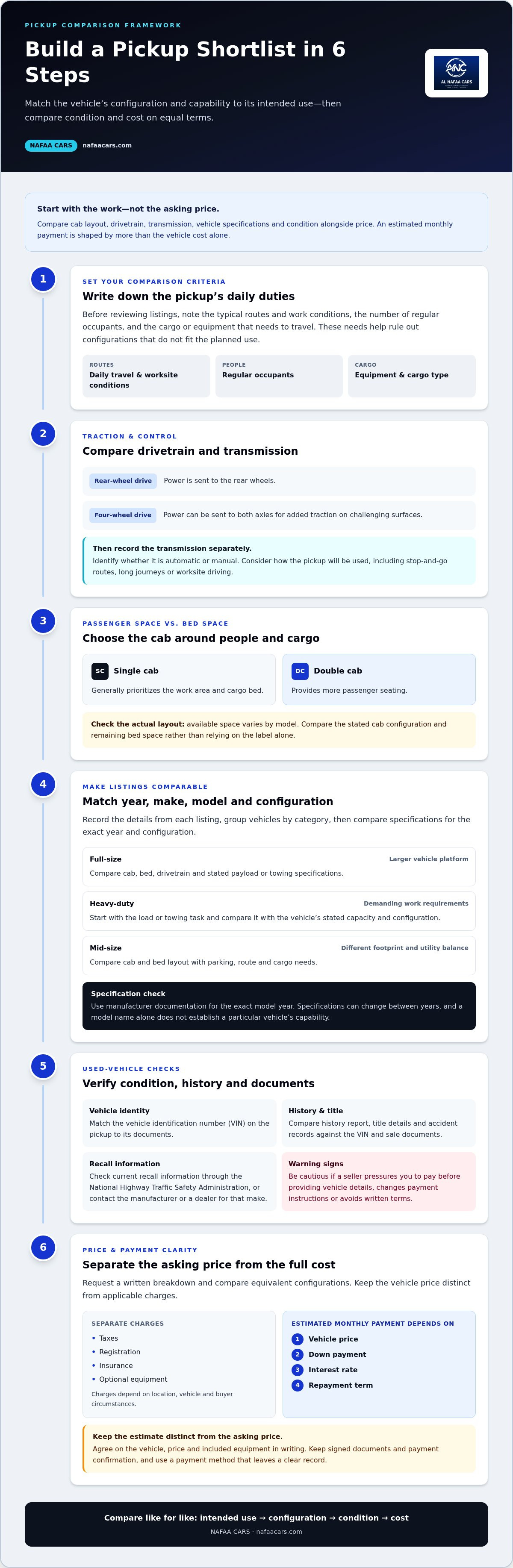
Compare drivetrain, transmission, and cab layout against the pickup’s daily duties. These choices affect traction, control, passenger space, and how clearly the listing describes the vehicle.
Drivetrain and Transmission Options
First, identify whether the listing describes rear-wheel drive or four-wheel drive. Rear-wheel drive sends power to the rear wheels; four-wheel drive can send power to both axles for added traction on challenging surfaces. Choose according to typical routes and work conditions, not the label alone.
Next, identify the transmission type: automatic or manual. Match it to how the pickup will be used, including frequent stop-and-go routes, long journeys or worksite driving. Record each pickup’s drivetrain and transmission separately so you can spot specification differences easily.
Cab Configuration Choices
Cab configuration determines the balance between seating and cargo-bed space. A single cab generally prioritizes the work area and bed, while a double cab provides more passenger seating. Layout and available space vary by model, so compare the stated configuration rather than relying on the label alone.
A crew transporting several people, for example, may prioritize a double cab. A pickup carrying equipment with fewer passengers may suit a single cab. Count regular occupants, consider what equipment must travel inside, and compare the remaining bed space. This helps prevent a mismatch between passenger needs and cargo duties.
Evaluate drivetrain, transmission and cab configuration together. A four-wheel-drive double cab may suit different operating needs from a rear-wheel-drive single cab. Use the intended route, number of occupants and cargo type as comparison criteria. Note them before reviewing listings, then rule out configurations that do not fit the planned use.
Transparent pricing starts with a written breakdown of the vehicle price and applicable charges. Separate the vehicle cost from taxes, registration, insurance and optional equipment, then compare equivalent configurations. An estimated payment also depends on the vehicle price, down payment, interest rate and repayment term. Keep that estimate distinct from the asking price.
Taxes, registration fees and insurance costs depend on the location, vehicle and buyer’s circumstances. Separate each charge from the vehicle price rather than treating them as a single total.
Be cautious if a seller pressures you to pay before providing vehicle details, changes payment instructions or avoids written terms. Match the vehicle identification number on the pickup to its documents, and keep a record of each payment.
Vehicle years, makes, and models
Compare pickups by model year, manufacturer and model before weighing individual listings. A consistent shortlist helps distinguish vehicle class and intended use from condition and equipment.
Full-Size Pickup Models
Full-size pickups suit buyers prioritizing a larger vehicle platform and broad work or passenger capability. Compare each model’s cab, bed, drivetrain and stated payload or towing specifications. Use the manufacturer’s documentation for the exact model year, since specifications can change between years.
Heavy-Duty Truck Models
Heavy-duty pickups are designed around demanding work requirements. Begin with the load and towing task, then compare the vehicle’s stated capacity with the equipment or trailer involved. Check the model-year specification sheet and configuration details together; a model name alone does not establish the capability of a particular vehicle.
Mid-Size Pickup Models
Mid-size pickups offer a different balance of footprint, passenger accommodation and work utility. Compare the model’s bed and cab layout with your daily parking, route and cargo needs. A buyer navigating confined work areas, for example, may value a more compact vehicle, while regular crew transport may make cabin layout the priority.
For a used pickup, compare its history report, title details and accident records against the vehicle identification number and sale documents. Before purchasing a pre-owned vehicle, check current recall information through the National Highway Traffic Safety Administration or contact the manufacturer or a dealer for that make.
Model year matters because equipment and specifications can change over a nameplate’s production run. Record the year, make, model and configuration from each listing, then compare matching details rather than similar-sounding names. Trim and cab designations can signal meaningful differences, so include them in your shortlist.
To complete a purchase safely, agree on the vehicle, price and included equipment in writing. Review the title and transaction documents, match the vehicle identification number, and use a payment method that leaves a clear record. Keep copies of the signed documents and payment confirmation.
Use this sequence to assess comparable listings:
- Record the model year, make, model, and configuration.
- Group vehicles by full-size, heavy-duty, or mid-size category.
- Compare specifications for the exact year and configuration.
- Review history, title, recall information, and accident records.
- Keep the agreed price and purchase documents together.
Pickup truck reviews shown on the page had an overall rating of 4.5 out of 5 from 10,233 reviews. Treat that overall rating as a broad reference when narrowing a shortlist, not as a guarantee that a particular pickup will suit your needs. Read individual comments for recurring observations about comfort, usability, and ownership, and consider whether they relate to the same model and configuration you are considering. Give more weight to details that match your intended use, such as passenger space, cargo tasks, or the way the vehicle drives in conditions similar to your own. Then assess the specific listing on its documentation, condition, and equipment. This keeps review impressions in perspective while you compare vehicles on details that matter to your purchase.
Engine, fuel type, and horsepower
Compare engine and fuel specifications with the pickup’s work requirements, not just its model name. A vehicle carrying tools on urban routes has different demands from one regularly hauling equipment over long distances. Horsepower describes engine power, while torque relates to rotational force. Both help explain performance, but neither alone determines suitability.
Start with the engine description in the listing and match it to the manufacturer’s specifications for that exact model and year. Engine size, configuration and fuel type can differ between versions with the same model name. A petrol version and a diesel version, for example, may have different specifications despite sharing a model designation. Compare figures for the specific vehicle, not another trim or year.
Horsepower helps compare a vehicle’s power output, but consider it alongside torque and the intended operating conditions. For a pickup carrying a steady load, consider how the engine delivers power during acceleration and regular work. A vehicle used mainly for light urban duties may have different priorities. Review the specifications together and compare them with the actual load and route requirements.
Fuel type affects the buying decision through the vehicle’s operating pattern and the fuel available along its routes. Petrol, called gasoline in the United States, and diesel are distinct options. Consider whether the pickup will make short journeys, travel long distances or perform repeated work under load. Match that pattern to the engine and fuel type stated in the vehicle documents. Fuel choice alone does not establish economy or capability.
Use a consistent comparison process for each listing:
- Record the exact model year, engine, and fuel type.
- Compare horsepower and torque figures from specifications for that version.
- Match the engine output to expected cargo, towing duties, and routes.
- Consider the vehicle’s regular journey pattern and fuel availability.
- Keep the specification details with the listing for direct comparison.
A pickup assigned to frequent loaded travel, for example, should be assessed against its stated torque, horsepower and engine configuration. A vehicle used for lighter local tasks may place greater importance on the match between its engine and daily route. In either case, compare the exact configuration rather than relying on broad claims such as “powerful” or “efficient.” Those descriptions cannot replace specifications.
Before narrowing your shortlist, confirm that the listing’s engine and fuel description match the vehicle documents. Then assess power output against the work plan and route. This keeps the comparison focused on verifiable specifications and practical use, rather than assumptions based on badges or model names.
Pickup truck prices and estimated monthly payments
An asking price is only one part of a pickup’s purchase cost. Compare the vehicle price, included equipment and transaction charges separately. For example, compare similar models using the same configuration and included features. When reviewing pickup vehicles for sale, this approach clarifies price differences and prevents equipment packages from obscuring the comparison.
Create a clear comparison record for each listing. Note the model year, make, model, cab, engine, condition and listed price, then record the included features or packages. A tow package affects the specification being compared, so distinguish a pickup equipped for towing from one without that equipment. Keep optional items separate from the base vehicle description.
An estimated monthly payment is calculated from the amount financed, interest rate and repayment term. A down payment reduces the amount financed; interest and the repayment schedule shape the resulting payment. Use the same assumptions for each estimate. Different terms or down payments produce figures that are not directly comparable, even when the pickups have identical asking prices.
Assess payment affordability separately from overall purchase value. A longer repayment term spreads repayment across more months, while the interest rate affects the total paid over that term. A lower estimated monthly payment alone does not mean one pickup costs less overall. Compare both the estimated payment and total repayment using consistent assumptions.
- Record the asking price and exact vehicle configuration.
- List included equipment separately from optional additions.
- Apply the same down payment to each comparison.
- Use the same interest rate and repayment term for each estimate.
- Compare estimated monthly payments alongside total repayment.
For transparent pricing, request an itemized written breakdown of the vehicle price, included equipment and each additional charge. Keep taxes, registration and insurance separate from the vehicle’s asking price. This shows what each amount covers and helps you compare equivalent configurations. It also keeps purchase costs distinct from financing estimates when organizing your comparison of pickup vehicles for sale.
Before relying on an estimate, check its inputs. Confirm that the vehicle price matches the selected pickup and that the down payment, interest rate, and term reflect the scenario being assessed. If one input changes, recalculate the estimate rather than carrying forward an outdated figure. A consistent method makes price and payment comparisons more useful for selecting a vehicle.
What should I check when inspecting a used pickup truck?
Inspect the pickup in a consistent order: documents, exterior, cabin, mechanical operation and road test. Compare each observation with the listing and vehicle identification number. A mismatch between the advertised model year and the documents, for example, needs clarification before purchase. Record visible concerns so you can assess the vehicle as a whole.
Start with the paperwork. Match the vehicle identification number on the truck to the title and sale documents. Review title details and available history records for ownership, reported damage and accident information. Before purchasing a pre-owned vehicle, check current recall information through the National Highway Traffic Safety Administration or contact the manufacturer or a dealer for that make.
Walk around the body in daylight. Look for uneven gaps, paint differences, dents, rust or signs of repair. Check the truck bed, tailgate and visible frame areas for damage or corrosion. Fresh paint in one section beside faded surrounding panels, for example, may warrant closer inspection. Check the tires for uneven wear, which can indicate alignment or suspension concerns.
Open the cab and test each door, window, seat adjustment and dashboard control. Check the seat belts, warning lights and air conditioning. Inspect the cargo bed for damage that could affect its intended use. If the pickup has a tow hitch, examine its visible condition and compare any included towing equipment with the listing.
With the engine running, note unusual sounds, warning lights, smoke or fluid leaks. Check that the transmission engages smoothly and that the steering and brakes respond during a road test. Drive a familiar route with low-speed turns and normal braking. These steps can reveal operational issues that a stationary inspection may not show.
Use a written checklist to keep your observations specific. Record findings by area rather than relying on memory, and separate visible defects from questions needing further assessment. For example, write “rust at the lower edge of the tailgate” instead of “body concern.” Specific notes are more useful when comparing used pickups.
- Match the vehicle identification number across the truck and documents.
- Review title, history, accident, and recall information.
- Inspect body panels, frame areas, tires, bed, and cabin controls.
- Start the engine and observe warning lights, sounds, and leaks.
- Road-test steering, transmission, and braking response.
Use your findings to compare the pickup’s condition with its advertised description and intended role. A detailed record helps distinguish cosmetic wear from concerns affecting operation, documentation or planned use.
Nafaa Cars: Pickup vehicles
Nafaa Cars provides pickup vehicles for buyers comparing configurations and model options for operational use. Its range includes Toyota Landcruiser Pick up Single Cab & Double Cab and Toyota Hilux Petrol & Diesel Pick Up, offering distinct cab and fuel-type configurations to assess against your requirements.
For specialized transport needs, Nafaa Cars also provides ambulance vehicle conversions. To start a focused enquiry, outline the intended use, preferred pickup model, cab configuration and fuel type. This gives the discussion a clear operational focus and helps define the vehicle requirement.
To discuss your pickup requirements, contact Nafaa Cars or visit Nafaa Cars pickup vehicles.
Turn Your Shortlist Into a Clear Requirement
A shortlist of pickup vehicles for sale is more useful when it reflects the work the vehicle must perform. Define the required passenger capacity, cargo needs, operating environment and any specialized purpose. This gives your next purchase discussion a practical brief rather than a broad model preference.
Nafaa Cars offers pickup vehicles, including Toyota Landcruiser Pick up Single Cab & Double Cab, as well as ambulance vehicle conversions. Share your intended use and preferred configuration to start a focused enquiry. A clear brief can also help organize the details for a personalized quotation.
Approach the decision as an operational choice: match the vehicle category to its role, then consider how it fits your wider requirements. If you are ready to discuss a suitable pickup, contact Nafaa Cars about pickup vehicles. A defined requirement is a strong next step toward a well-considered purchase.
Frequently Asked Questions
What financing options and interest rates are available for pickup truck buyers?
Nafaa Cars sells pickup vehicles but does not provide vehicle financing or set interest rates. Buyers in Dubai can assess financing separately by comparing lender terms for the vehicle, repayment period and borrower profile. Before deciding, calculate the total repayment as well as the regular payment, and keep financing costs separate from the vehicle’s purchase price. This clarifies the overall budget without confusing vehicle procurement with lending.
How do popular pickup truck models compare in towing capacity, payload, fuel economy, and price?
Compare towing and payload specifications for the exact model year and configuration, alongside the vehicle price and stated fuel details. No model-specific fuel economy or price figures are provided here, so particular pickups cannot be ranked on that basis.


