

A vehicle can be a legal structure, not a road vehicle. In finance, special purpose vehicles are independent legal entities created to manage investment in a particular project. In commercial transport, the same phrase can describe vehicles configured for specific operational roles.
That distinction matters because the purpose, structure and practical benefits differ. Financial special purpose vehicles can separate a project’s assets and liabilities from its sponsor’s wider business. In transport, a purpose-built or converted vehicle is selected to meet the demands of a specific task.
This article explains how financial SPVs are structured and used, the advantages they may offer, and the risks and responsibilities involved. It also clarifies how special purpose vehicles relate to specialist transport, helping business decision-makers identify the meaning relevant to their needs.
Key Takeaways
- Distinguish a project-focused legal entity from a vehicle configured for a specialist operational role.
- Understand how a financial structure can ring-fence a project’s assets, liabilities, and investment activity.
- Compare potential benefits, such as pooled investment and defined exposure, with governance and reporting responsibilities.
- Recognize how investor eligibility rules can affect who participates in a US offering.
- Use the vehicle meaning to assess whether a pickup or conversion suits a specific business requirement.
Definition and purpose of special purpose vehicles
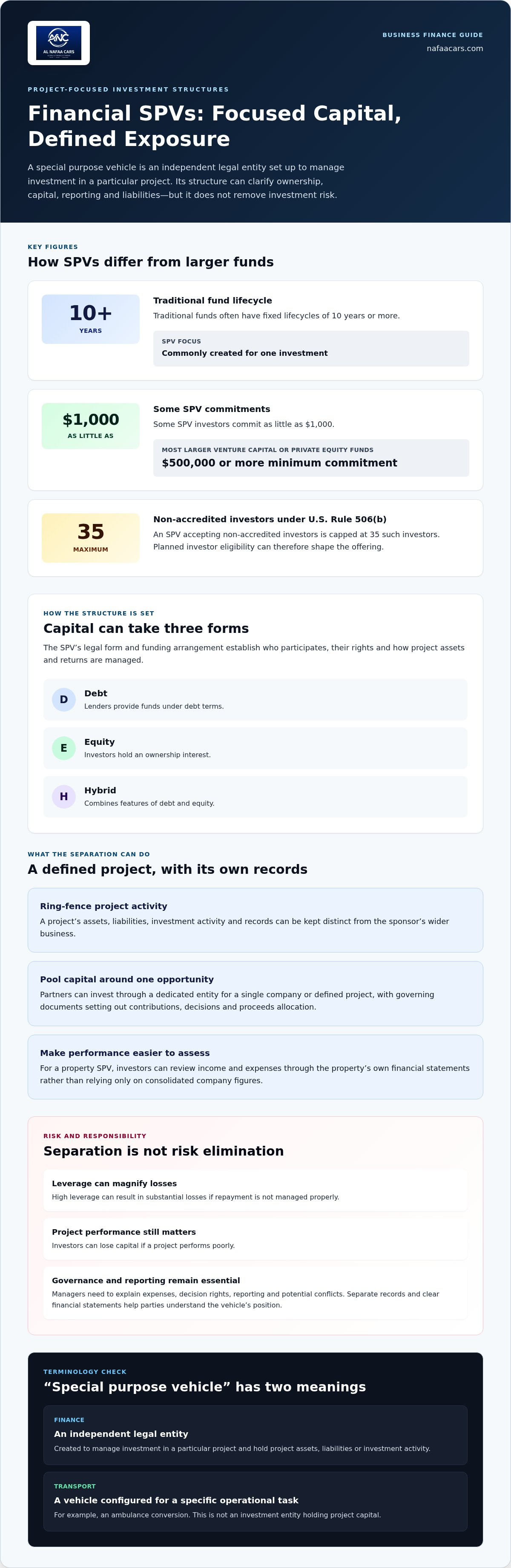
In finance, special purpose vehicles are independent legal entities established to manage investment in a particular project. The abbreviation SPV refers to this project-specific structure, not the assets or business of its sponsor. For example, a property developer could use a separate entity to hold one development and its associated obligations. This separation gives investors and managers a defined framework for handling capital, ownership, reporting, and liability.
An SPV’s legal form and funding arrangement determine how it operates. Its capital may be organized as debt, equity, or a hybrid of both. Equity investors hold an ownership interest, while lenders provide funds under debt terms. A hybrid combines features of both. The structure sets out the parties involved, their rights, and how the project’s assets and returns are managed. It also keeps the vehicle’s statements and records distinct from those of its parent company.
That separation can help contain a project’s financial exposure. When a parent company places a specific asset and related liabilities in an SPV, the vehicle’s obligations can be distinguished from the parent’s other activities. This does not remove the need to manage debt, maintain records, or meet applicable obligations. High leverage can result in substantial losses if repayment is not managed properly. Clear financial statements and separate records help parties understand the vehicle’s position.
Asset securitization is one established use. A bank can transfer a pool of loans or receivables to a separate entity, which then supports securities issued to investors. Mortgage-backed securities are one example: holders may have first priority to payments on the transferred loans. An SPV can keep the transaction’s specified assets and payment arrangements distinct from the bank’s other business. Investors still need to understand the assets, their performance, and the risks attached to the vehicle.
Project investment is another use. Partners can pool capital through an SPV to invest in one company or a defined project. Early-stage real estate, technology, and renewable energy ventures commonly use this approach. For example, investors may participate in a single technology company through a dedicated entity rather than joining a broader private equity fund. The SPV’s governing documents describe how capital is contributed, decisions are made, and proceeds are allocated.
Investor eligibility and offering terms also shape the structure. In the United States, under Rule 506(b), an SPV accepting non-accredited investors is capped at 35 such investors, according to the U.S. Securities and Exchange Commission. This limit makes the planned investor group relevant before an offering proceeds. Managers also need to explain expenses, decision rights, reporting, and potential conflicts. When the sponsor manages the SPV, its interests may differ from those of outside investors.
Jurisdiction matters because an entity established in one country can conduct business elsewhere. It must still comply with applicable local rules in the places where it operates. For financial reporting, IFRS 10 replaced IAS 27 and SIC 12 for consolidated financial statements for periods beginning on or after 1 January 2013. That history illustrates why accounting treatment and legal formation are distinct considerations. A structure’s name alone does not determine whether a parent company must consolidate it.
Financial SPVs should also be distinguished from specialist road vehicles. In transport, the phrase can describe a vehicle configured for a specific operational task, such as an ambulance conversion. These special purpose vehicles are not investment entities holding project capital. The wording is shared because both serve a specific purpose, but the context changes its meaning. First identify whether the discussion concerns finance or transport.
SPV purpose and advantages
A project-specific entity can give investors a defined route into a single opportunity. For example, a group considering one early-stage technology company can pool capital through an investment vehicle dedicated to that company. The sponsor can set out ownership, decision rights, and proceeds allocation for the investment. This focused structure distinguishes the project’s financial activity from that of a broader fund or parent company.
That focus can make participation more adaptable. Traditional funds often have fixed lifecycles of 10 years or more, while an SPV is commonly created for one investment. Investors can assess the target company and its terms without committing to a diversified portfolio. Some SPV investors commit as little as $1,000, compared with minimum commitments of $500,000 or more at most larger venture capital or private equity funds.
Separate ownership can also help define financial exposure. An SPV holding a project’s assets and liabilities keeps those records distinct from its sponsor’s other activities. If a renewable energy project encounters financial difficulty, this separation can help limit the parent company’s exposure to the project’s obligations. It does not eliminate risk: high leverage can magnify losses, and investors can lose capital if the project performs poorly.
Real estate offers a practical example. A sponsor can create an entity to hold one property, receive income, and record expenses associated with that asset. Investors can then assess the property’s performance through its own financial statements, rather than relying only on consolidated company figures. Where a property depends on permits, placing the asset and associated permits together can also support transfer as a package when individual permit transfers are difficult.
For a sponsor, this structure can organize capital from multiple parties around a defined transaction. Each investor’s rights, contribution terms, and share of proceeds can be recorded in the governing documents. In asset securitization, for example, a defined pool of receivables supports a specific financing arrangement. The benefit is greater transaction clarity: investors can identify which assets support the investment and how payments relate to them.
International structuring can provide access to different investment arrangements, but it adds administrative demands. An entity established in one jurisdiction may operate elsewhere and must follow applicable local rules in each place. Separate books, financial statements, tax filings, and regulatory records require disciplined administration. A sponsor should account for these responsibilities when comparing a dedicated vehicle with direct ownership or participation in a larger fund.
Costs and oversight also affect the net advantage. In 2023, the median management fee among SPVs that charged one was 1.9%; the middle 50% charged between 1.5% and 2%. Fees can reduce investor returns, while legal, accounting, and reporting work adds administrative effort. Investors also need adequate information about assets, performance, and risks. If the sponsor manages the vehicle, conflicts can arise when its interests diverge from those of investors.
A useful assessment weighs the project’s scale, investor group, asset ownership, reporting burden, and exit plan. A single-company investment with clearly defined assets may suit a dedicated entity; a broader portfolio may require a different structure. Financial SPVs should also be distinguished from transport usage, where purpose refers to a vehicle’s operational role. For that separate meaning, specialist vehicle applications provide a relevant point of reference.
Special-purpose entities are commonly used to securitize loans or other receivables, creating a defined pool of assets around which financing can be arranged. Companies can also pool investment from multiple market participants into an SPV to help manage the capital structure. This can be useful when a company wants to bring together capital for a particular arrangement while keeping the structure tied to that investment. An SPV may let limited partners invest in a company without committing their entire investment upfront or paying significant management fees, offering a different way to participate than a larger pooled fund.
The separation can also matter if an investment defaults. An SPV can limit investors’ liability to the amount they invested, protecting their personal assets in the event of default. Separating an SPV’s assets and liabilities from those of its parent company can help limit exposure and potential losses, though it does not remove investment risk or ensure repayment. The jurisdiction chosen for the vehicle may also affect its financial treatment: an SPV may be established in a tax-efficient jurisdiction to potentially reduce taxes on income and capital gains. Any such benefit is potential, not assured. Consider jurisdictional choices alongside the vehicle’s purpose, obligations, and allocation of risk. These features can make an SPV useful for structuring participation, but they do not make the underlying investment safer or guarantee a particular financial result.
Nafaa Cars: Pickup vehicles
Nafaa Cars helps organizations source pickup vehicles when transport requirements call for a practical, task-focused vehicle rather than a financial investment structure. Its offerings include Toyota Landcruiser Pick up Single Cab & Double Cab and Toyota Hilux Petrol & Diesel Pick Up. Procurement teams can assess these options against the intended use, passenger or cargo needs, and operating conditions.
For specialist response requirements, Nafaa Cars also offers ambulance vehicle conversions. The right choice depends on the vehicle’s role, whether that calls for general pickup use or a converted ambulance platform. Defining the required function first helps align sourcing with practical deployment needs.
To discuss pickup vehicles or ambulance vehicle conversions, contact Nafaa Cars or visit nafaacars.com.
Set the Right Direction for Your Next Requirement
Start by defining the operational role your vehicle must perform, then align sourcing decisions with that requirement. Special purpose vehicles can refer to distinct concepts in finance and transport. Keeping the intended use clear helps decision-makers move from general research to a practical procurement brief.
For organizations sourcing purpose-focused transport, Nafaa Cars offers pickup vehicles, ambulance vehicle conversions, and Toyota Landcruiser Pick up Single Cab & Double Cab options. These offerings support different operational needs, from pickup duties to ambulance use. Separating transport requirements from financial discussions about special purpose vehicles helps teams identify the relevant vehicle category.
Take the next step by discussing your vehicle requirement directly with Nafaa Cars. Contact Nafaa Cars today to continue the conversation and move your sourcing plans forward with clarity.
Frequently Asked Questions
What is a special purpose vehicle?
In transport, a special purpose vehicle is a road vehicle selected or converted for a defined operational role, such as ambulance response. The term also has a financial meaning: special purpose vehicles can be independent legal entities created for a particular investment or project. Context determines which meaning applies. For a fleet or procurement team, the vehicle’s intended task distinguishes it from an investment structure.
What is a special purpose vehicle (SPV)?
An SPV is the financial meaning of the term: an independent legal entity established around a particular project or investment. It is not a road vehicle. For example, an investor reviewing an SPV would assess its legal structure and investment purpose, while an operations team in Dubai sourcing an ambulance would be discussing a transport vehicle configured for a specific role. The shared name describes distinct concepts.


