
Personal effects cannot travel inside a vehicle shipped by roll-on/roll-off (RoRo). Container shipping can accommodate spare parts or related cargo when arranged appropriately. This distinction is an important early decision in the international vehicle export process, because the shipping method affects how the vehicle and any accompanying cargo are prepared.
Exporting a vehicle involves more than booking freight. Ownership documents and vehicle details must align, the shipment must be prepared, suitable cover selected, and customs clearance planned at both ends. This guide explains how to work through those steps, including what to consider when comparing RoRo, container and air freight, and how destination duties and delivery fit into the process.
You’ll also learn how to reduce avoidable delays by keeping vehicle and shipping records consistent, preparing for destination requirements before departure, and arranging the return or collection of original documents after clearance. The result is a clearer plan for managing an international shipment and its paperwork from export preparation through final delivery.
Key Takeaways
- Choose RoRo when the vehicle is operable and carries no personal effects; container shipping can suit non-running vehicles and properly arranged related cargo.
- Prepare for document handling after arrival: original vehicle papers may be used for destination customs clearance, then returned or collected with the vehicle.
- For a vehicle exported by vessel or aircraft from the United States, U.S. Customs and Border Protection requires the vehicle and required documentation to be presented at least 72 hours before export.
- Plan destination admissibility, duties, registration requirements, and delivery before the vehicle leaves, so import arrangements align with the shipment documents.
- Record the vehicle’s condition before shipping and review marine cargo insurance terms to understand what protection applies during transit.
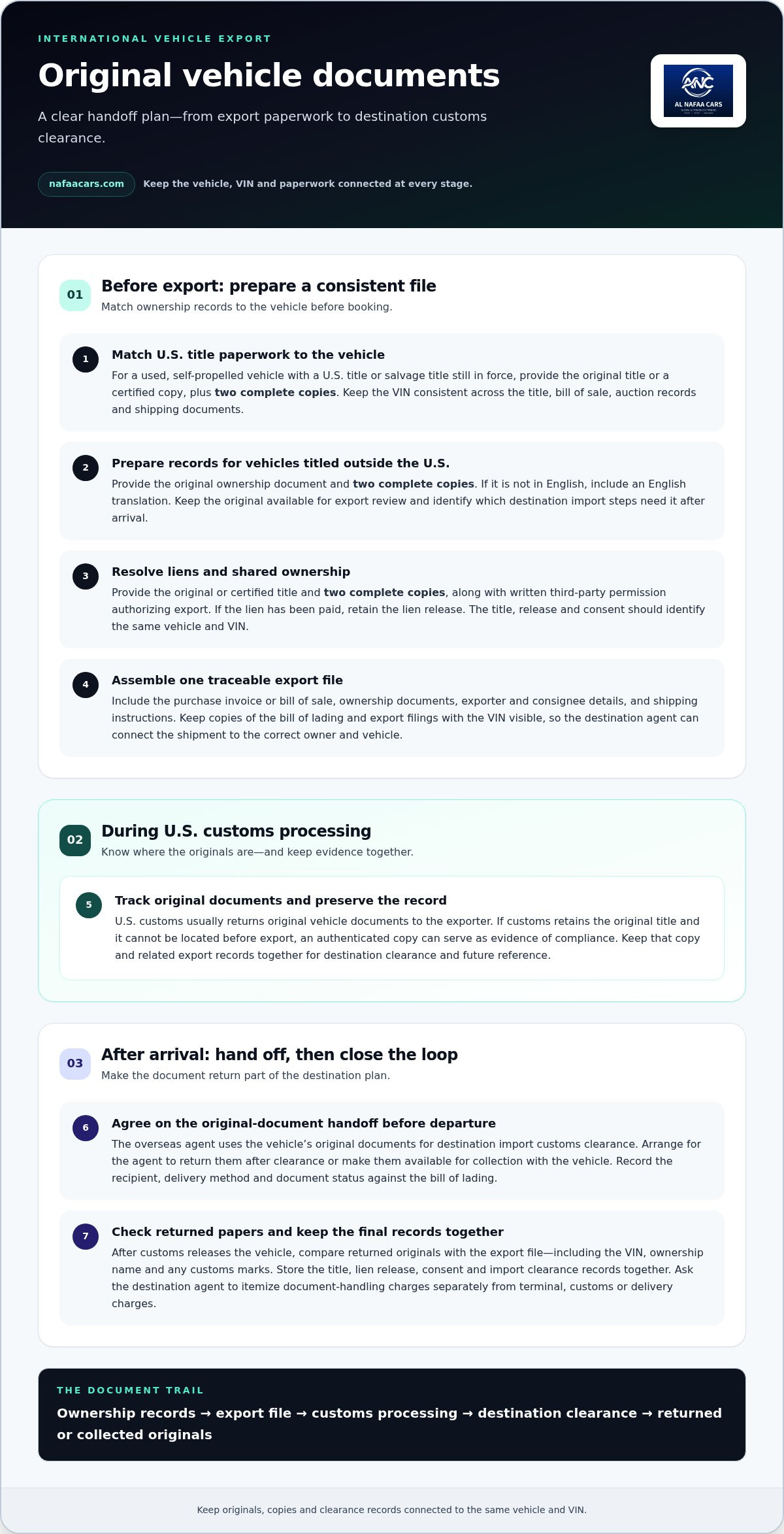
Returning original documents after customs clearance
- Match ownership paperwork to the vehicle before export. For a used, self-propelled vehicle with a U.S. title or salvage title still in force, provide the original title or a certified copy and two complete copies. Keep the VIN consistent across the title, bill of sale, auction records and shipment documents. A mismatch can delay release while records are corrected.
- Prepare a separate document set for a vehicle titled or registered outside the United States. Provide its original ownership document and two complete copies. If the document is not in English, include an English translation. Keep the original available for export review, then identify which destination import steps require it after arrival.
- Resolve liens and shared ownership before booking the shipment. Provide the original or certified title and two complete copies, along with written permission from the third party authorizing export. If the lien has been paid, retain the lien release with the ownership records. The title, release and consent should identify the same vehicle and VIN.
- Assemble export paperwork as one traceable file. Include the purchase invoice or bill of sale, vehicle ownership documents, exporter and consignee details, and shipping instructions. Keep copies of the bill of lading and export filings with the VIN visible. This document set helps the destination agent connect the shipment to the correct owner and vehicle.
- Track original documents through U.S. customs processing. U.S. customs usually returns original vehicle documents to the exporter. If customs retains the original title and it cannot be located before export, an authenticated copy can serve as evidence of compliance. Preserve the copy and related export records together for destination clearance and future reference.
- Agree on the document handoff before the vehicle departs. The overseas agent uses the vehicle’s original documents for destination import customs clearance. Arrange for the agent to return them after clearance or make them available for collection with the vehicle. Record the recipient, delivery method and document status against the bill of lading.
- Close the paperwork loop after customs releases the vehicle. Compare returned originals with the export file, including the VIN, ownership name and any customs marks. Store the title, lien release, consent and import clearance records together. Ask the destination agent to itemize document handling charges separately from terminal, customs or delivery charges.
RoRo, container, and air-freight options
Compare vehicle condition, destination, cargo needs and delivery priorities before selecting freight.
-
Compare RoRo, container, and air freight
Choose a method that fits the vehicle, destination and priorities in your international vehicle export process. RoRo carries operable vehicles aboard specialized vessels, while containers can accommodate non-running vehicles. RoRo is commonly used for standard passenger and commercial vehicles, but personal effects are not allowed inside. Container shipping can suit premium or specialist vehicles, while air freight is faster and generally reserved for urgent or high-value movements.
Check battery-powered vehicle requirements with the carrier because state of charge, safety declarations, and classification can affect acceptance. Shared-consolidation containers take 20-45 days from warehouse receipt to departure. Port-to-port ocean transit takes 20 to 60 days, depending on origin, destination, routing, and mode. Allow additional time for handling and onward delivery.
-
Load and secure the vehicle in a container
Plan loading around vehicle dimensions, weight, running condition, damage, and ground clearance. A dedicated 20-foot container is recommended for one vehicle to reduce contact damage. A 40-foot container may suit a different loading plan. Spare parts or related cargo can travel in a container when the shipment is structured correctly.
Before loading, confirm the vehicle’s position, loading sequence, weight distribution and tie-down points. Secure it with suitable restraints, such as heavy-duty straps, wheel restraints, timber supports or blocking. Photograph the vehicle and its secured position for condition records. Compare the loading plan with container details and shipping documents to ensure the correct vehicle and equipment are recorded.
-
Compare shipping costs by method
Request a freight comparison using the same vehicle, pickup location, destination and delivery scope. These figures describe shipping costs, not a complete landed-cost estimate. Port charges, destination handling, customs and inland transport affect the final outlay.
Include this comparison in your international vehicle export process by requesting each shipment stage as a separate line item, including collection, storage, loading, ocean freight, and destination handling. A missed vessel cutoff or terminal delivery window can cause delays and move cargo to another sailing. For vehicle export planning, review vehicle export options alongside the shipping method and destination requirements.
Customs clearance, duties, and destination delivery
Coordinate export presentation, origin clearance, destination duties and final delivery before the vessel or aircraft departs. Customs release depends on aligned paperwork and completed import requirements.
-
Coordinate freight forwarders and customs
Appoint an experienced freight forwarder to coordinate carrier schedules, customs submissions and port delivery. For U.S. exports, provide the forwarder with the VIN, ownership records, consignee details, shipping instructions and transport information. A third-party agent commonly needs a letter of authorization to act on the exporter’s behalf.
For a vehicle exported by vessel or aircraft from the United States, U.S. Customs and Border Protection requires the vehicle and required documentation to be presented to Customs at least 72 hours before export. For a vehicle exported from the United States by rail, highway, or under its own power, U.S. Customs and Border Protection requires the required documentation to be submitted to Customs at least 72 hours before export.
Ask the forwarder to align the customs deadline with terminal receiving dates, vessel schedules and documentation cutoffs. Port delivery is not the same as completed export clearance. Keep the customs submission record and shipment reference together so the dealer or consignee can track the file.
-
Handle origin port customs clearance
Prepare the vehicle and original ownership documents for the origin inspection. U.S. customs officers typically compare the vehicle with its paperwork, assess authenticity and mark original documents. Make the VIN readable and ensure it matches the title, export filing and shipping records. Incorrect or inconsistent details can stop release until corrected.
Before moving the vehicle to the port, confirm its receiving appointment, carrier instructions and export documentation deadlines. Customs release does not mean the vehicle has been loaded or exported. Track each milestone separately: port arrival, inspection, customs clearance, terminal acceptance and vessel loading.
Retain the bill of lading and export filing details after departure. These records identify the shipment and support destination processing. A customs broker or freight forwarder can coordinate submissions, but the exporter remains responsible for supplying accurate vehicle and ownership information.
-
Clear destination customs and duties
Plan destination import clearance before export by identifying the vehicle’s admissibility, required documents, duties and registration standards. At the destination port, import authorities review paperwork, calculate applicable duties and verify local compliance. Customs charges may be accompanied by terminal handling and local agent fees.
Rates vary by destination and vehicle classification. The stated U.S. import duty is 2.5% for cars and 25% for trucks. The stated European Union import duty is approximately 10%, in addition to VAT. Middle East vehicle import duties often range between 5% and 15%.
After arrival, coordinate customs inspection, payment of assessed taxes and duties, and vehicle release. Then arrange registration procedures and transport from port to the final location. Transit planning should include port handling, transshipment where applicable, destination discharge, customs processing and inland delivery. Keep original documents accessible for import clearance and return them to the owner or authorized recipient after use.
Defining vehicle requirements and destination-market needs
Match the vehicle, ownership records, export method and destination rules before arranging departure. A vehicle’s U.S. paperwork alone does not establish eligibility at its destination.
-
Check used vehicle export requirements
For a used, self-propelled vehicle with a U.S. title or salvage title still in force, U.S. Customs and Border Protection requires the original title or a certified copy and two complete copies. Keep the VIN consistent across the title, vehicle and export records. A mismatch can interrupt processing at the border.
Compare the vehicle’s ownership document with the planned export method and shipment details. U.S. export requirements can depend on the vehicle’s title status and whether it is self-propelled. For a vehicle titled or registered abroad, provide its original ownership document and two complete copies. Include an English translation if the document is not in English.
Keep the paperwork organized before pickup. For a vehicle without a title or Manufacturer’s Statement or Certificate of Origin, document whether its jurisdiction requires ownership papers and retain original proof, such as a dealer invoice or bill of sale.
-
Verify vehicle title and salvage title requirements
Review the title’s status and vehicle identification number before committing to logistics. U.S. ownership records may include clean titles, salvage titles, rebuilt titles, salvage certificates or other state-issued documents. Confirm that the document remains valid and identifies the vehicle being shipped.
If using a certified title copy, use one issued by an authorized government agency. It must include a signed statement authenticating the original. A purchase invoice or bill of sale can help document lawful ownership when title records do not apply, but it must identify the vehicle by VIN.
Separately assess destination standards. Check whether the destination accepts the vehicle’s condition, specifications, and left-hand or right-hand drive configuration. A vehicle suitable for one market may require modifications or additional approvals before import. For Saudi Arabia or Kuwait, vehicles over 5 years old and under 30 years old require import approval.
-
Confirm title and lien requirements
Resolve liens and shared ownership before booking transport. For a vehicle with a recorded lien or shared ownership, provide the original or certified title and two complete copies, along with written permission from the third party authorizing export. Keep any lien release with the title documents.
Check that the consent or release identifies the correct vehicle and VIN. The owner’s name, lienholder details and shipment records should not conflict. If the title is held by a lender, obtain the required release and export authorization before departure, rather than relying on a later paperwork correction.
Finally, compare ownership documents with destination import requirements. A customs broker needs a clear record connecting the exporter, consignee and vehicle. Complete these checks before paying a deposit or arranging pickup, so the chosen vehicle and export method fit the destination’s entry rules.
Marine insurance and condition records
Marine cargo insurance is generally the relevant cover for a vehicle in transit.
-
Review marine insurance and carrier coverage
Compare the marine cargo policy with the carrier’s liability terms before shipment. That limit may not reflect the vehicle’s value, so distinguish carrier liability from separate insurance when reviewing the documents.
Check how the policy defines the insured vehicle, shipment route and covered transit period. Confirm that the declared value matches purchase documentation and that the Bill of Lading identifies the correct vehicle. Retain the policy and shipping records together for claims coordination.
-
Arrange marine cargo insurance
Arrange marine cargo insurance using the vehicle’s documented value and shipment details. Premiums typically range from 1-2% of the vehicle’s value. For example, provide the insurer with the purchase invoice, vehicle identification details, shipping method, and destination country so the cover can be matched to the movement.
Read the policy terms for covered events, exclusions, claim evidence and notification procedures. Keep a copy accessible to the owner and the party coordinating the shipment. Do not treat the carrier’s limited total-loss liability as equivalent to a separate marine policy.
- Record the vehicle’s condition before handover. Create a dated condition report before collection or terminal delivery. Photograph each exterior side, the cabin, visible damage, odometer and major equipment. Record operational status where applicable, then retain the images with the vehicle’s identification and shipment paperwork.
A clear record helps distinguish pre-existing damage from changes observed after arrival. Use consistent images and descriptions at origin and destination. If the vehicle is non-running, document that status and any visible loading or handling concerns before container loading.
- Keep insurance and condition records aligned. Compare the condition report, vehicle identification, declared value and Bill of Lading before departure. Correct discrepancies in the documentation while the vehicle remains at origin. Save copies of correspondence, policy documents, inspection notes and delivery records in one file.
For fleet or specialist shipments, coordinate records for each vehicle separately. Different condition, equipment, or value details should not be combined into a single generic entry. To review vehicle options before planning a shipment, explore vehicle choices.
Nafaa Cars: Pickup vehicles
Nafaa Cars offers pickup vehicles for buyers sourcing vehicles for commercial, fleet or specialist requirements. Its range includes Toyota Landcruiser Pick up Single Cab and Double Cab models, Toyota Hilux Petrol and Diesel Pick Up vehicles, and ambulance vehicle conversions.
Consider these options when your procurement plan calls for a pickup platform or a converted ambulance vehicle. Before selecting a vehicle for export, align its specifications and intended use with destination-market requirements, including admissibility, documentation and registration standards. This connects vehicle sourcing with the customs and shipping steps covered above, while keeping destination checks essential.
For vehicle enquiries, visit Nafaa Cars online or contact Nafaa Cars.
Move from planning to the right vehicle
The next decision is whether the vehicle fits your operational requirements and destination market. A disciplined international vehicle export process starts by aligning intended use, vehicle specification and import criteria before procurement moves forward.
Nafaa Cars offers pickup vehicles, including Toyota Landcruiser Pick up Single Cab and Double Cab models, as well as ambulance vehicle conversions. These options may suit buyers sourcing a work vehicle or a purpose-converted vehicle for institutional use. Consider how the vehicle will be deployed, who will receive it and which local standards apply before selecting a configuration.
With those requirements defined, you can move into procurement with a clearer basis for evaluating vehicle suitability and export planning. Contact Nafaa Cars about exporting your vehicle to discuss your vehicle requirements and next steps.
Careful preparation makes an international shipment a more structured purchasing decision. Start with a vehicle specification that supports the work it must perform, and carry that clarity through to delivery.
Frequently Asked Questions
Can I leave items inside the vehicle?
No, personal effects are not allowed inside vehicles shipped by roll-on/roll-off. For container freight, spare parts or related cargo can travel when the shipment is structured correctly. Treat the vehicle and its cargo as separate items in the loading plan, with accurate descriptions and documentation. For example, list spare parts as cargo rather than leaving them loose inside the vehicle. Ensure the container plan accounts for the cargo’s placement and securing.
How long will it take to ship my car?
Port-to-port ocean freight typically takes 20 to 60 days, depending on origin, destination, routing, and shipping mode. Shared container consolidation takes 20 to 45 days from warehouse receipt to departure, before ocean transit begins. Air freight is faster, but generally serves urgent or high-value vehicle movements. Build your schedule around the actual route and method, and distinguish vessel departure from arrival, customs release, and final inland delivery.
What are the critical timing steps to avoid export delays?
Work backward from the vessel cutoff, allowing time for vehicle pickup, document preparation, customs presentation, and terminal delivery. For U.S. exports by vessel or aircraft, U.S. Customs and Border Protection requires the vehicle and required documentation at least 72 hours before export. For rail, highway, or export under the vehicle’s own power, required documentation must be submitted to Customs at least 72 hours before export. Missing a port cutoff can move the shipment to another vessel.
What are the steps to export a vehicle internationally from the United States?
First, confirm the vehicle’s ownership documents and match the VIN across the vehicle and shipping records. Select a transport method, prepare exporter and consignee details, and coordinate port delivery. EEI filing through AES is required for every self-propelled vehicle exported from the United States, regardless of value, with no $2,500 exemption. The filing generates an ITN, which CBP requires before loading is authorized. Arrange the applicable Customs presentation or documentation submission deadline.
How do I check import requirements for a vehicle in the destination country?
Start with the destination’s admissibility rules, duties, registration standards, and required customs documents. Check whether the vehicle’s age, condition, specifications, and left-hand or right-hand drive configuration meet local requirements. For example, vehicles exported to Saudi Arabia or Kuwait that are over 5 years old and under 30 years old require import approval. Align the import paperwork with the consignee and customs broker before departure to reduce correction work after arrival.
How long does international car shipping and customs clearance take?
Ocean port-to-port transit typically takes 20 to 60 days, while unloading and destination import customs clearance typically take about 7-14 business days. These periods cover different stages. Total delivery also includes origin handling, possible transshipment, destination discharge, inland transport, and registration steps. For example, a vessel’s arrival date does not mean the vehicle is cleared or ready for collection. Plan around each milestone rather than sea transit alone.
What export taxes, duties, tariffs, and fees apply to vehicle shipments?
Charges depend on the destination, vehicle classification, and import rules. The stated U.S. import duty is 2.5% for cars and 25% for trucks; the European Union import duty is approximately 10%, in addition to VAT. Middle East import duties often range from 5% to 15%. Destination expenses can also include terminal handling, import customs clearance, and local agent handling. Separate these import charges from freight and origin-port costs in your landed-cost plan.
How do I choose a vehicle shipping company and compare transport methods?
Compare transport methods against vehicle condition, destination, cargo needs, budget and delivery requirements. RoRo is commonly used for operable vehicles, while container shipping can accommodate non-running vehicles and properly arranged related cargo. Air transport is faster and generally suits urgent or high-value movements. When choosing a shipping company, assess how its stated scope aligns with your shipment stages, including collection, export paperwork, port coordination, destination clearance and delivery arrangements.


